NAACP calls for athletes to consider HBCUs amid Black voter suppression

Votercanva
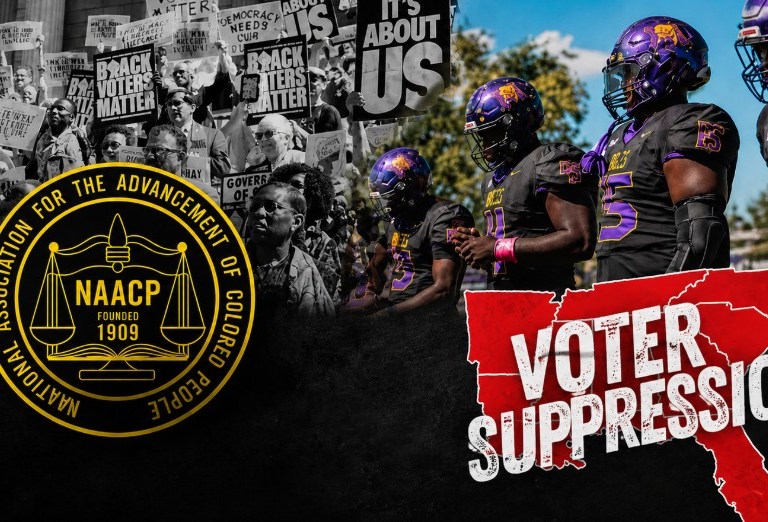
The NAACP is speaking out about the recent Supreme Court decision affecting Black voting rights and is using college sports to make a stand.

Tuesday morning, the organization announced the “Out Of Bounds” campaign, which calls for Black student-athletes and stakeholders to withdraw financial support from public universities in states that have moved to limit, weaken, or erase Black voting representation.

The campaign is targeting flagship public institutions in South Carolina, Georgia, Mississippi, Louisiana, Texas, Florida, Tennessee and Alabama.

“The NAACP will not watch the same institutions that depend on Black athletic prowess to fill their stadiums and their bank accounts remain silent while their states strip Black communities of their voice,” NAACP CEO and president Derrick Johnson said in the organization’s statement.

NAACP wants Black athletes to consider HBCUs

The campaign also calls to action Black athletes to make three considerations, including:

      • Black athletes and recruits are asked to withhold commitments from targeted programs, to ask coaches and athletic directors where their universities stand on voting rights, and to visit and seriously consider HBCUs.
      • Current college athletes are asked to use their platforms to elevate the issue, to ask institutional leadership for public statements opposing racial vote dilution, and to consider all available options under the transfer portal.
      • Fans, alumni, donors, and consumers are asked to stop purchasing tickets, merchandise, and licensed apparel from targeted programs and to redirect that spending to HBCUs — their athletics programs, scholarship funds, NIL collectives, bands, and alumni foundations.


    View this post on Instagram


    A post shared by COURIER (@couriernewsroom)


    “Out Of Bounds is our answer; we are naming the contradiction, and we are calling on Black athletes, families, fans and consumers to act on it. The same power that built these programs can be redirected. And it will be.”

SWAC History: Shirley Walker paved the way for women’s basketball to thrive

Screenshot 2026 05 17 145819
This article is one in a series of features produced in partnership with the Southwestern Athletic Conference, exploring the history of the SWAC from its founding in 1920 to the present day. The series will run in April and May.

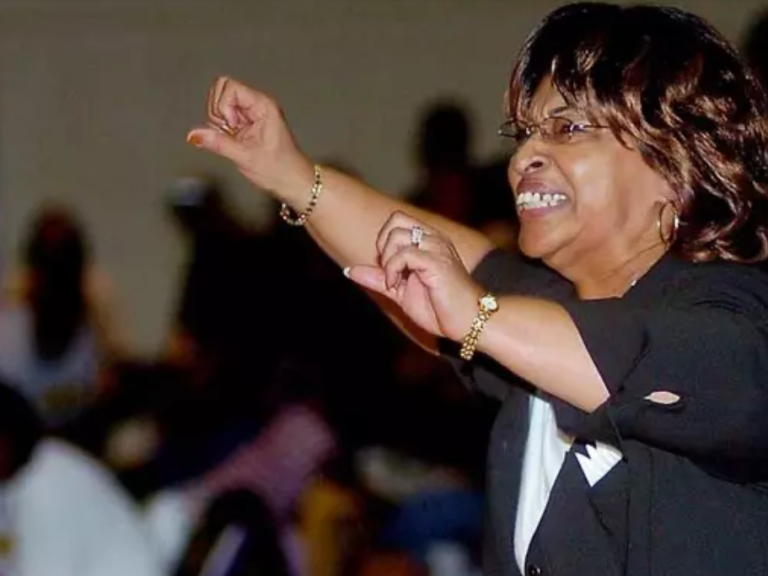
Alcorn State’s men’s basketball program received most of the headlines and attention during the 1980s, but over the course of 30 years, the Lady Braves’ women’s basketball program was just as successful thanks to their long-time head coach, Shirley Walker.

Walker’s focus on disciplined basketball and her vision to create something that would benefit the HBCU women’s hoops community have earned her several honors and the admiration of the Alcorn State community.

A native of Bude, Mississippi, she graduated from Alcorn State and began coaching the Braves women for the 1978-79 season.

She replaced her husband, Lonnie, who would serve as men’s basketball assistant during the Braves’ runs to the NCAA tournament.

While men’s basketball had become a national sensation in those days, women’s college basketball came from humble beginnings.

Shirley Walker fought for NCAA Tournament inclusion

Outside of the Cheyney State teams led by C. Vivian Stringer, HBCU women’s hoops was no different.

The SWAC was not originally included in the NCAA tournament, or its predecessor, the AIAW (Association for Intercollegiate Athletics for Women) tournament.

After the NCAA began its own women’s basketball tournament in 1982, it would not be until the late 90s when the SWAC earned an automatic bid to the Big Dance.

Walker, who served on the NCAA women’s basketball committee for years, was instrumental in the SWAC finally receiving an autobid.

By the time the 2000 SWAC women’s basketball tournament rolled around, the Lady Braves had something of a bridesmaid’s reputation.

At the time, Alcorn had won eight regular-season championships and three SWAC tournament titles (pre-autobid) under Walker, but was still seeking its first NCAA tournament appearance.

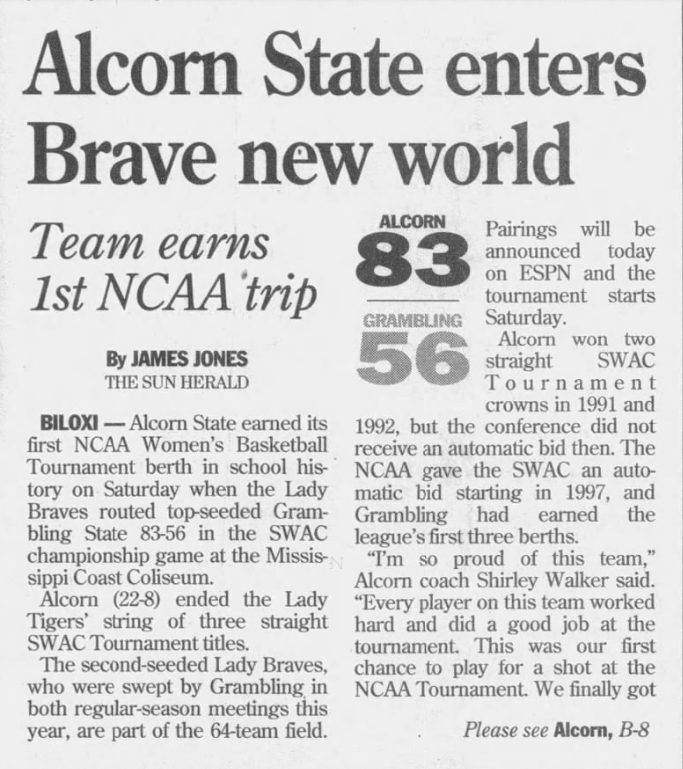
Alcorn State was the second seed in the tournament at 15-3, two games behind Grambling at 17-1. Both teams advanced to the championship at the Mississippi Coast Coliseum in Biloxi, Mississippi.

After losing twice to the Tigers in the regular season, the third time proved to be the charm for the Lady Braves.

Junior forward/center Cherea Wood, the tournament’s most outstanding player, recorded a double-double of 14 points and 18 rebounds, and guard Daisha Reed scored 17 points as Alcorn State rolled over Grambling 83-56 for the SWAC title and their first appearance in the NCAA tournament.

Walker put women’s basketball on the map

“I’m still in a little shock,” Walker told the Biloxi Sun Herald after Alcorn State drew Louisiana Tech on Selection Sunday. “I’m still on Cloud Nine. The entire program did a great job of getting the team into the tournament. I’m proud of the girls for working hard to get there.”

Gracious in defeat, Grambling coach Rusty Ponton credited Walker for the SWAC, earning a spot in the NCAA tournament.

“Shirley helped put SWAC women’s basketball on the map,” he said. “She did everything possible to promote this conference. I have always considered Shirley as one of the top coaches in the nation.”

Walker would have a chance to test herself against one of the very best in Louisiana Tech’s Leon Barmore, who announced his retirement before the tournament began.

Not a team to be intimidated or upstaged, Alcorn went into the Thomas Assembly Center and gave the Lady Techsters a challenge in the first half. Kamrica Turk’s three-pointer at the 7:40 mark of the first half pulled the Lady Braves within 27-25.

Unfortunately, Louisiana Tech went on a 14-0 run soon after and cruised to a 95-53 win.

“When they get the momentum going, they are hard to stop,” Wood said afterward. “But I’m proud that we never quit.”

“I was pleased with how we played,” Walker said. “We got frustrated, but we weren’t intimidated.”

Walker’s Alcorn State women would repeat as SWAC tournament champions in 2001 and won one more SWAC title in 2005.

Walker left a lasting SWAC legacy

By the time she departed the coach’s chair in 2008, Shirley Walker had won 493 games, still the most for any SWAC women’s basketball coach.

And the awards and rewards continued to roll in after her coaching days wound down.

During the 2014-15 season, the court at the Whitney Complex was renamed the Shirley A. Gibbs-Walker Court and she was also awarded the SWAC’s lifetime achievement award.

“This award means a lot. When someone looks over your work and realizes how much you put your heart and mind into what you have done, it shows that the conference appreciates your accomplishments,” Walker said. “It means a lot to be a part of this conference.”

For a woman who spent a large portion of her career in the shadows of her own school as well as some conference rivals, the story of SWAC women’s basketball and SWAC women’s sports as a whole cannot be told without Shirley Walker.

A woman who served as head women’s basketball coach at her alma mater not only put the program on the map but also paved the way for everyone else in the conference to share in the joy of earning a trip to the NCAA tournament.

HBCUs will get paid collective $6.9 million to play against FBS opponents in ’26

SPORTS Football V FAMU 7 JW
The guarantee game remains an important and controversial exercise in HBCU football.

This fall, at least 15 matchups between Division I HBCU programs and FBS opponents will collectively generate more than $6.9 million to Black College coffers.

Using the confirmed list of HBCU versus FBS payout game parameters compiled by Hero Sports for the 2026 season, here is a look at all the matchups and the dollars associated with them.

Florida A&M tops HBCU payouts

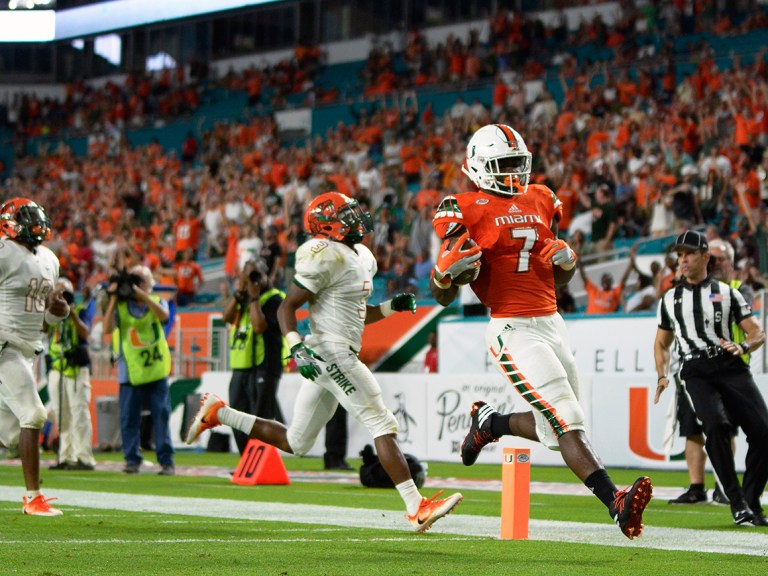
At the top of the payout list is Florida A&M, which will reportedly receive $740,000 for its trip to Miami. It’s the kind of high-profile in-state matchup that not only brings financial value but also visibility for one of the premier programs in the FCS ranks.

Photo: Justin Ford/HBCU Sports

Several other programs will hit the $600,000 mark. Morgan State heads west for a matchup against Arizona State, while Tennessee State travels to face SEC powerhouse Georgia. Both games highlight the growing willingness of Power Five programs to schedule HBCUs — and pay accordingly.

Arkansas-Pine Bluff ($550,000 at Missouri) and Howard — which has two such games on its schedule — also stand out.

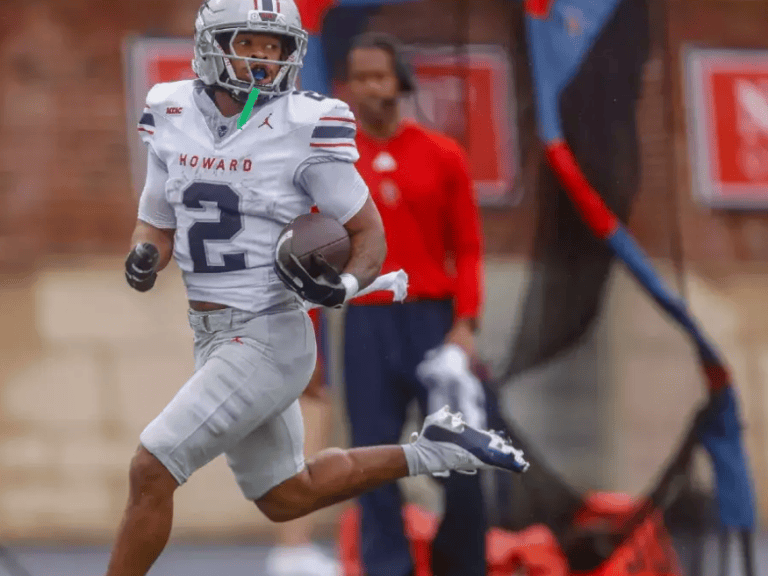
Howard to play at College Football Playoff national champions

The Bison will earn a combined $1 million between trips to Indiana ($525,000) and Rutgers ($475,000), making them one of the biggest financial winners of the 2026 slate.

In the mid-tier range, Hampton ($475,000 at Maryland) and Delaware State ($450,000 at USF) continue the trend of MEAC and CAA programs leveraging these matchups for revenue. North Carolina Central ($425,000 at East Carolina) and Norfolk State, which has two games totaling $720,000 (Virginia and Old Dominion), also benefit from multiple opportunities.

Further down the list, Prairie View A&M and Alcorn State will each collect $400,000 for games against Baylor and Southern Miss, respectively. Alabama State ($360,000 at Troy) and North Carolina A&T ($225,000 at Georgia State) round out the group.

The payouts vary widely, but the purpose remains the same. These games are often labeled “guarantee games” for a reason — the financial return can help offset the costs of running an entire athletic department.

And occasionally, there’s more than just a check on the line.

Upsets like Howard’s historic win over UNLV in 2017 or North Carolina A&T’s victory over East Carolina in 2022 serve as reminders that while these matchups are often viewed as tune-ups for FBS programs, they can become defining moments for HBCU teams.

In 2026, the stakes will once again include both dollars and opportunity — with nearly $7 million on the table and the chance, however slim, to make history.

Balanced dominance lifts Jackson State to SWAC Commissioner’s Cup

Jackson State Cup Champs
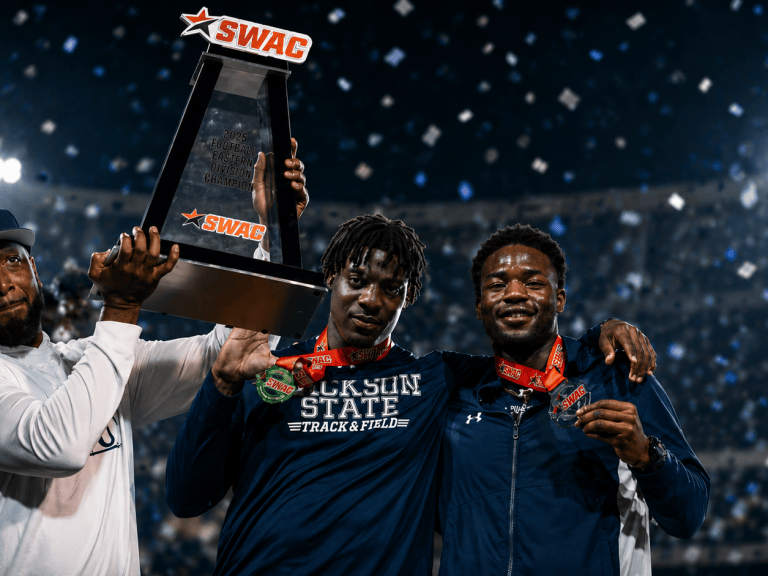
The margin was razor-thin, but when the dust settled on the 2025-26 Southwestern Athletic Conference season, Jackson State stood alone at the top.

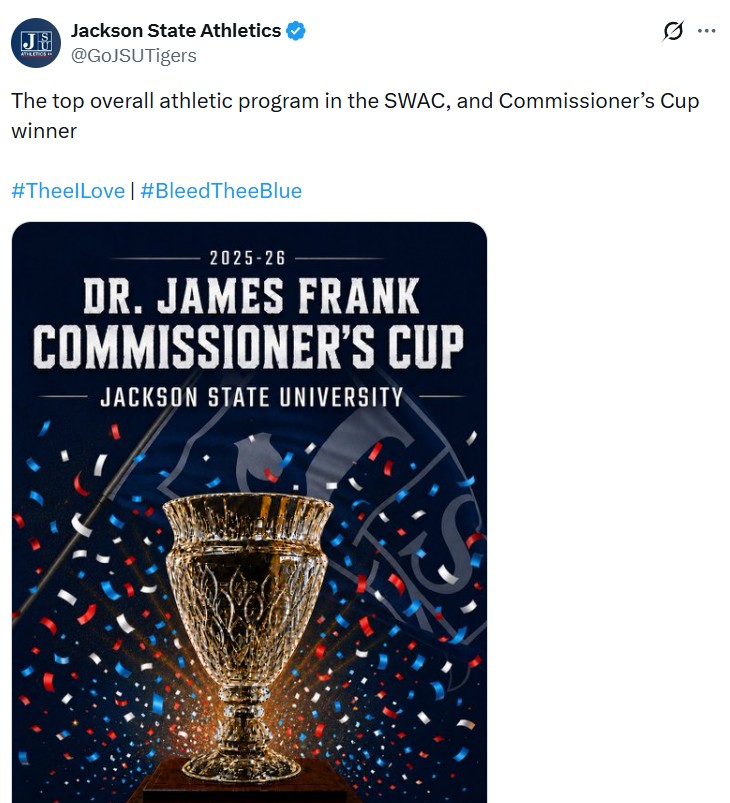
Powered by consistent excellence across multiple programs, the Tigers captured the Dr. James Frank Commissioner’s Cup with 152.0 total points, narrowly holding off Alabama State, which finished just three points behind at 149.0. It marks a statement year for Jackson State athletics — not defined by dominance in one sport, but by balance across the board.

“Winning the Commissioner’s Cup is a by-product of the hard work put in by our coaches and student-athletes,” director of athletics Ashley Robinson said in a statement. “The competitive balance of the Southwestern Athletic Conference is at an all-time high, and that makes this one special. This doesn’t happen without the hard work of all of our teams, our administration, and support staff. We continue to set the standard in everything we do, as we continue to build on traditions and blaze new trails.”

The Commissioner’s Cup, awarded annually to the conference’s top-performing overall athletic program, reflects success across all league-sponsored sports. And in that regard, Jackson State proved to be the most complete program in the SWAC this year.

Balanced Excellence Lifts Jackson State

Rather than leaning on a single standout program, Jackson State built its championship run through steady, high-level finishes on both sides of competition. The Tigers placed second in both the men’s standings (69.0 points) and women’s standings (83.0 points), showcasing depth that ultimately made the difference.

That consistency allowed JSU to edge Alabama State, which delivered a dominant performance in women’s sports but couldn’t fully close the gap on the men’s side.

Despite finishing second overall, Alabama State can claim one of the most impressive single-category performances of the year. The Hornets captured the women’s all-sports title — the Magee/Jacket Award — with a league-best 92.0 points.

Their women’s programs set the pace across the SWAC, finishing well ahead of Jackson State and Southern. However, a fifth-place finish in the men’s standings (57.0 points) ultimately left them just short of the overall crown.

Bethune-Cookman Claims Men’s Crown

On the men’s side, Bethune-Cookman emerged as the conference’s top program, securing the C.D. Henry Award with 70.5 points. Jackson State (69.0) and Texas Southern (68.0) followed closely behind in a tightly contested race.

The Wildcats’ strong showing helped propel them to an eighth-place finish in the overall standings, despite a lower placement in women’s competition.

Texas Southern continued its rise as a consistent contender, finishing third overall with 138.5 points. The Tigers also placed third in men’s competition and fifth on the women’s side, reinforcing their position as one of the league’s most balanced programs.

Southern claimed fourth place overall with 133.5 points, highlighted by a strong third-place finish in women’s standings.

Florida A&M rounded out the top five with 123.0 points, buoyed by solid finishes on both the men’s and women’s sides.

The battle for positioning remained competitive throughout the standings. Prairie View A&M (119.5) narrowly edged Alabama A&M (119.0) for sixth place, while Bethune-Cookman followed in eighth.

Arkansas-Pine Bluff, Alcorn State, Grambling State, and Mississippi Valley State completed the final standings.

A Conference Defined by Depth

The 2025-26 SWAC season underscored the league’s growing parity and depth. While Alabama State showcased elite dominance in women’s sports and Bethune-Cookman led the men’s field, Jackson State’s across-the-board consistency ultimately proved to be the championship formula.

In a race decided by just three points, every finish mattered — and the Tigers made just enough of them count.

HBCU makes history with first woman to lead women’s basketball program

SHAW COACH Youtube Thumbnail
A successful Division II HBCU women’s basketball program has been led by men throughout the team’s history.

That will change in the 2026-27 season.

Ebony Tanner, who recently coached Elizabeth City State, has been named Shaw University’s new women’s basketball coach, making her the first woman in school history to serve in that capacity.

“I am incredibly excited and honored to return to Shaw University,” Tanner said in a statement released by the university. “Shaw is a place rich in tradition, excellence, and pride, and being a Lady Bear means representing something bigger than yourself. The legacy built by the women and coaches before us is special, and I’m grateful for the opportunity to continue that tradition while pouring into the next generation of Lady Bears. I can’t wait to get to work and represent this university, our alumni, and our community with passion and pride.”

What to know about Ebony Tanner

Tanner previously worked at Shaw as an assistant coach and recruiting coordinator for four seasons, including a 2008 CIAA championship. She was also an assistant coach at the University of Hartford and her Alma mater, the University of Richmond.

Photo: Ebony Tanner/Twitter

As a player, Tanner was a two-time all Atlantic-10 selection and left the Lady Spiders ranking among the program’s leaders in points, rebounds, blocked shots, and field goal percentage.

Tanner coached ECSU for two seasons and, prior to that, led St. Augustine’s to a winning record before the school ceased athletic operations amid an ongoing financial crisis.

Tanner replaces interim coach Lou Hamilton, who was let go after replacing legendary coach Jacques Curtis days before the 2025-26 season began.

Curtis retired suddenly after allegations of abuse within the Lady Bears program began to surface.

MEAC football teams with the toughest and easiest OOC schedules in 2026

Screenshot 2025 10 26 074357
Now that the 2026 football schedules are mostly finalized, what does the MEAC’s non-conference road look like?

By using the 2025 record for each non-conference opponent, we rank each MEAC team’s schedule before conference play begins in mid-October.

1. Howard

Home games: Richmond (7-5), Morehouse (3-7)

Road games: Indiana (16-0), Rutgers (5-7), Penn (6-4)

Neutral sites: Alabama A&M for the MEAC/SWAC Challenge (4-8), Hampton for the Truth & Services Classic (2-10)

2025 non-conference opponents’ total record: 43-41 (.512)

Outlook: Bison legend Ted White’s return to DC is going to be full of challenges, including a trip to FBS national champion Indiana as well as HU’s yearly visit to Rutgers and a visit from usual FCS contender Richmond.

Games against Alabama A&M, Hampton and Morehouse highlight the HBCU portion of the schedule and will likely tell us what kind of team the Bison will be in 2026.

2. Delaware State

Home games: Stony Brook (6-6), Bowie State (3-7), Towson (6-6), Franklin Pierce (6-4)

Road games: William & Mary (7-5), South Florida (9-4), U. of Albany (2-10)

2025 non-conference opponents’ total record: 38-43 (.469)

Outlook: Year two of the DeSean Jackson era at DSU features three Coastal Athletic Association opponents, a trip to FBS bowl participant South Florida… and somebody named Franklin Pierce for homecoming.

A slight step up in non-conference foes for the Hornets will require Jackson’s rebuilding project to move quickly, especially with a tougher MEAC schedule on the horizon.

3. North Carolina Central

Home games: Elizabeth City State (4-6), North Carolina A&T (2-10), Campbell (2-10), William & Mary (7-5)

Road games: Texas Southern (6-5), Gardner-Webb (7-5), East Carolina (9-4)

2025 non-conference opponents’ total record: 37-45 (.451)

Outlook: After an unaccustomed third-place MEAC finish in 2025, Trei Oliver and the Eagles look to rebound with a favorable home schedule, a trip to Houston to face an improved Texas Southern team and a battle at FBS bowl participant East Carolina.

Each game features a chance for a new group of NCCU football players to make their mark and stake a claim as a contender for the MEAC title.


4. South Carolina State

Home games: Savannah State (4-6), Virginia State (6-4), The Citadel (4-8)

Road games: Furman (6-6), Bethune-Cookman (6-6), Charleston Southern (5-7)

Neutral sites: Florida A&M for the Orange Blossom Classic (5-7)

2025 non-conference opponents’ total record: 36-44 (.450)

Outlook: The two-time defending MEAC champions and Celebration Bowl champions have a very regionalized schedule, which should help them heading into MEAC play.

Two trips to Florida against FAMU (the Orange Blossom Classic in Miami Gardens) and Bethune-Cookman highlight the schedule and could be the tell as to what kind of title defense Chennis Berry and his Bulldogs will have in 2026.

5. Norfolk State

Home games: Winston-Salem State (4-6), Hampton (2-10), Virginia-Lynchburg (2-9)

Road games: Old Dominion (10-3), Virginia (11-3), Chicago State (N/A), Robert Morris (3-9)

2025 non-conference opponents’ total record: 32-40 (.444)

Outlook: The Michael Vick experience at Norfolk State enters Year Two with some heavy hitters (ODU and Virginia) and the unknown of a brand-new FCS program, Chicago State.

The Spartans have a favorable home schedule against D-II Winston-Salem State, a Hampton team with a new coach, and the Washington Generals of HBCU Football, Virginia-Lynchburg. Anything outside of 2-1 in that non-conference home schedule would be disappointing…and perhaps cause for alarm.

6. Morgan State

Home games: Virginia-Lynchburg (2-9), Robert Morris (3-9)

Road games: North Carolina A&T (2-10), Arizona State (8-5), Towson (6-6), Villanova (12-3), Tennessee State (2-10)

2025 non-conference opponents’ total record: 35-52 (.402)

Outlook: Damon Wilson and Morgan State have only two home games in their non-conference slate, but winnable, nonetheless. Robert Morris is coming off a down 2025 and VUL…well. You know.

The road schedule is the Bears’ biggest test with trips to FCS semifinalist Villanova, FBS member Arizona State, and North Carolina A&T and Tennessee State teams looking to redeem themselves after rough 2025 campaigns. Morgan will need a strong showing in these games if they are to make a move in the MEAC title race.

NBA star Chris Paul delivers final assist to Morehouse College graduates

CHRIS PAUL
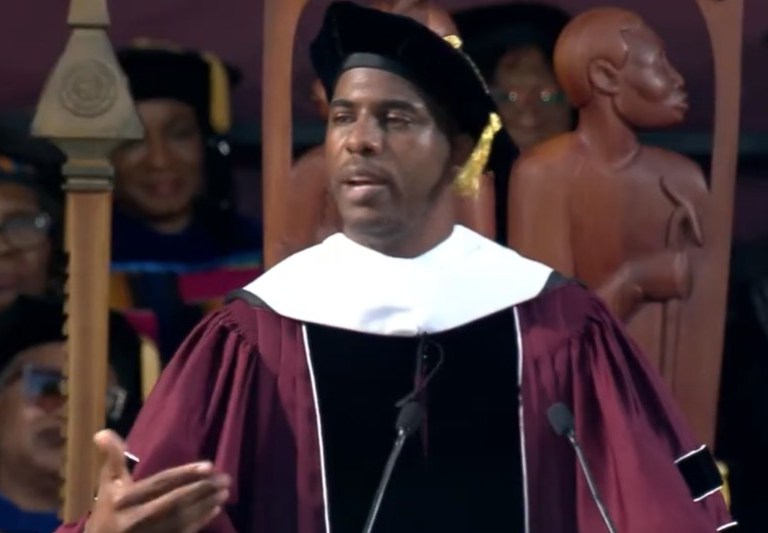
Chris Paul didn’t just show up at Morehouse College to deliver a commencement speech—he showed up to deliver a message rooted in accountability, legacy, and purpose.

Standing before the Class of 2026, the future Hall of Fame point guard immediately set the tone, soaking in the moment and the meaning of the space.

“This is different. This is really different. This is Black excellence,” Paul said, acknowledging the weight of speaking at one of the nation’s most historic HBCUs.

The 12-time NBA All-Star, now stepping into what he described as a “new chapter… beyond basketball,” connected his own journey to the graduates in front of him. Though he began his college career at Wake Forest, Paul proudly reminded the crowd of his HBCU ties to Winston-Salem State, bridging his experience with the brotherhood of Morehouse.

And while he sprinkled humor throughout—joking about his honorary doctorate and insisting on being called “Dr. Paul”—his core message was serious: success isn’t guaranteed, and the degree alone won’t carry you.

“You gotta make this more than just a piece of paper,” he told the graduates. “Who you are, what you value, how you carry yourself… that’s what will make all the difference.”

Lessons from the game—and life

Paul distilled his message into two guiding principles, both shaped long before his NBA stardom.

The first came from his late college coach, Skip Prosser: don’t just be a “3-to-6 guy”—someone who only works when required—be a “6-to-3 guy,” committed to the unseen hours of preparation.

“Do you only put in the work when the lights are bright,” Paul asked, “or are you self-motivated when no one is watching?”


He paired that lesson with a personal story—one of the few times in his career he didn’t start a game. Not because of talent, but because he overslept and showed up late.

That moment, he explained, taught him a defining truth: “Accountability is where everything starts and ends.”

The second principle was bigger than basketball: make the mission bigger than yourself.

Paul reflected on moments of adversity, including being traded without warning and navigating intense leadership scrutiny as president of the NBA Players Association during a turbulent era. Through it all, he emphasized collective purpose over personal pride.

“I don’t know how to be halfway in and halfway out. I’m all in,” he said.

That mindset, he explained, is what allowed him to lead, adapt, and ultimately help secure meaningful progress for players across the league.

A message for Morehouse men

Paul didn’t shy away from the realities awaiting the graduates, particularly as Black men entering professional spaces where they may often stand alone.

“There will be plenty of rooms… where you’re the only person that looks like you,” he said. “My challenge to you is not to build a wall—it’s to build a bigger table.”

It was a line that resonated deeply, tying into both his leadership philosophy and the broader legacy of Morehouse.

He urged the graduates to lean on one another, to value mentorship, and to embrace the responsibility of lifting others as they climb.

“If you are thriving and nobody else around you is,” Paul said, “that ain’t it.”

Despite a decorated 21-year NBA career, Paul acknowledged what many critics often point out—he never won an NBA championship.


View this post on Instagram


A post shared by G. Paras Griffin (@thephotomanlife)

But in a moment of clarity and perspective, he reframed that narrative.

“I’ve accepted it,” he said. “Because I gained so much more.”

For Paul, legacy isn’t defined by rings, but by impact—on teammates, on communities, and on future generations.

He shared stories of his father, his late grandfather—who owned a gas station in North Carolina—and Coach Prosser, all of whom shaped his understanding of work ethic, ownership, and accountability.

“Ownership,” he said, echoing his grandfather, “is the difference between waiting for change and becoming the reason change happens.”

Chris Paul delivers final assist

As the speech closed, Paul turned the focus back to the graduates, challenging them directly.

“Are you going to be a 6-to-3 guy? Are you going to make the mission bigger than you? Are you going to inspire us to be what we know we can be?”

For the Morehouse Class of 2026, the message was clear: the degree is just the beginning. The real work—the meaningful work—comes next.

SWAC History: Ralph W. E. ‘Prez’ Jones spent 51 years doing the impossible at Grambling

Prez1
This article is one in a series of features produced in partnership with the Southwestern Athletic Conference, exploring the history of the SWAC from its founding in 1920 to the present day. The series will run during the months of April and May.

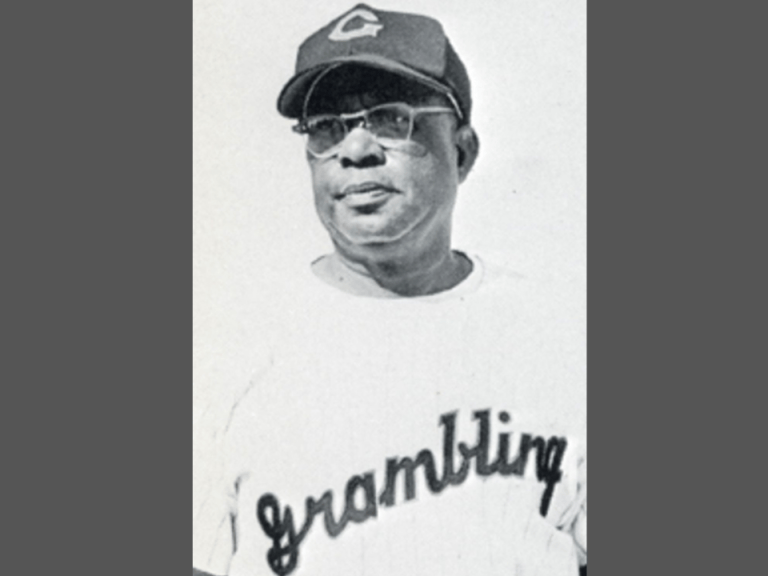
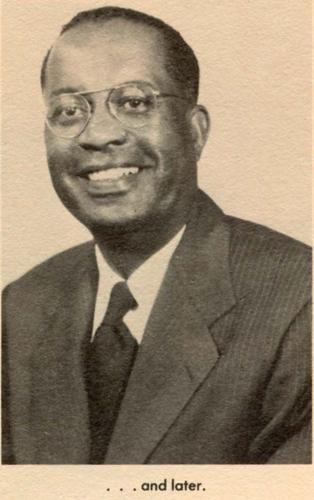
Ralph Waldo Emerson Jones took on more roles than most people could imagine. He served as the second president of Grambling State University and was also a championship-winning baseball coach.

He also hired the man who would become the winningest coach in college football history, and he managed all of this at the same school and at the same time for over 40 years. People called him “Prez,” and the name suited him well.

An accidental hire who became the school’s builder

Jones came to Grambling in 1926 due to a case of mistaken identity. Grambling founder Charles P. Adams had interviewed five men from Southern University’s 1925 graduating class, all of them star athletes.

He was the smallest of the group and joked that he was “the star scrub” who sat at the end of the bench. It was discovered that Adams mixed up his notes and hired Jones by mistake. And when the error was discovered, Adams decided to keep Jones on board.

Not only did Jones teach chemistry, math, and biology, but he also served as the college registrar and dean of men. He also started and coached the school’s baseball team and put together the school’s first football team.

And in 1926, with no budget and no instruments, he ordered a set of instruments out of a Sears catalog and founded what would become the “World-Famed Tiger Marching Band.” By the time he became president in 1936, he had already shaped more of Grambling’s identity than anyone else.

R.W.E Jones
Photo: Grambling College

A coach who also happened to run the university

When Jones became president in 1936, he stepped back from most of his other roles. But baseball was the exception. He kept coaching, and he kept winning.

During his 41 seasons as the Tigers’ head coach, Jones had a record of 816 wins and 218 losses. His teams won six Midwest Athletic League titles and five SWAC championships. He led Grambling to four NAIA tournaments and finished as national runners-up in 1963 and 1964.

In 1967, he was named NAIA Coach of the Year. He coached 11 All-Americans, including Ralph Garr, who won the National League Batting Title with the Atlanta Braves in 1974. Jones ended his coaching career with a .789 winning percentage, all while serving as the school’s president.

The hire that changed college football

In 1941, a 22-year-old Eddie Robinson came to Grambling looking for a job coaching football. Jones was the person who interviewed Robinson, and Jones was the one who hired him.

Robinson spent 56 seasons at Grambling and finished with 408 wins, 17 SWAC championships, and 9 Black college national titles. He sent more than 200 players to the NFL and was inducted into the College Football Hall of Fame in 1997.

Ralph Waldo Emerson Jones

Building Grambling into a university

When Jones took over as president, Grambling (then known as the Louisiana Negro Normal and Industrial Institute) had 120 students and 17 faculty members. When he retired in 1977, enrollment had reached 4,000, and the faculty had grown to 500.

But there is a very unique story about how Jones managed to change the name of the Louisiana Negro Normal and Industrial Institute to Grambling.

According to Mildred G. Gallot’s A History of Grambling State University, Jones went before the Louisiana State Legislature to make his case for changing the school’s name. He sensed that lawmakers were not fully engaged in what he was saying. So he changed his approach, stating, “Besides all that, the name is too long, when we are playing football, and the other team has the ball on our five-yard line, the other team has already scored by the time our cheerleaders can say ‘hold that line, Louisiana Negro Normal and Industrial Institute.’” Those in attendance erupted with laughter, and as a result, legislation was passed to name the school Grambling College in 1946.

Jones also wrote the school’s alma mater and created the school’s motto, “Where Everybody is Somebody.”

His longtime assistant and successor as baseball coach, Wilbert Ellis, described him this way: “No matter what the color of the skin, he just wanted to reach out and help people. That’s what he came to Grambling to do.”

Jones’ legacy speaks for itself

Jones was inducted into the NAIA Hall of Fame in 1964, the SWAC Hall of Fame in 1992, and the National College Baseball Hall of Fame in 2011. Grambling included him in its inaugural Hall of Fame class in 2009.

The school’s baseball facility was renamed Wilbert Ellis Field at RWE Jones Park in 2011. R.W.E. Jones Drive remains one of the main roads on the Grambling campus.

Jones died on April 9, 1982. More than 2,000 people attended his memorial service at Grambling State. He was a president, a coach, a builder, and a founder, all at the same time and at the same school.

Bethune-Cookman big first helps clinch back-to-back SWAC regular season titles

Bcubaseball
Bethune-Cookman left no doubt en route to a SWAC regular-season championship.

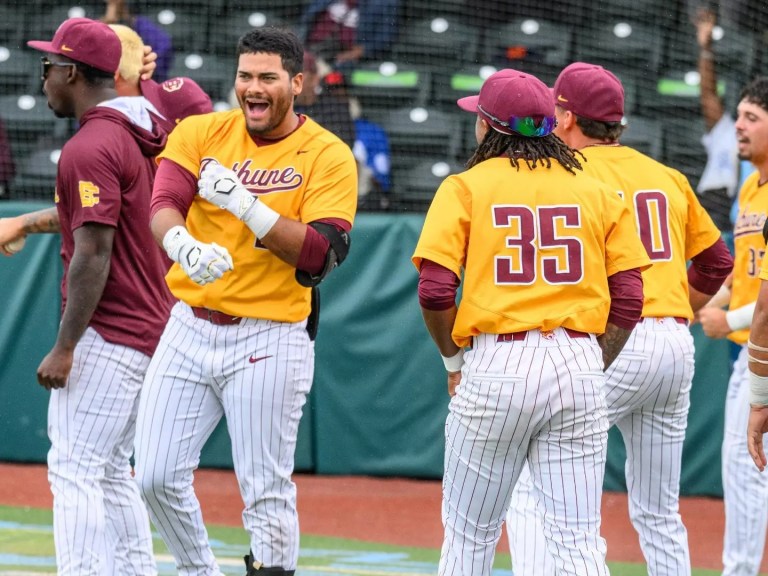
The Wildcats pounded out 11 hits in a 12-1 run-rule win over Grambling State on Saturday.

Title-clinching start

The game was effectively decided in the opening inning, when Bethune-Cookman sent 11 batters to the plate and scored nine runs on six hits, while also taking advantage of walks, hit batters, and aggressive baserunning.

Darryl Lee sparked the rally with a double, and Andrey Martinez followed with a single, and the Wildcats kept stacking productive at-bats until the inning turned into a runaway. By the time the first frame ended, B-CU had turned a close game into a celebration.

Bethune-Cookman, which finished the regular season with a program record 37 wins, tallied 16 hits, led by Darryl Lee’s three-hit night and multi-hit efforts from Andrey Martinez, Erick Almonte and Sergio Rivera.

Lee drove in two runs, while Almonte added two RBIs and Martinez scored twice to help keep the pressure on Grambling throughout the night. Michael Rodriguez also reached base repeatedly and scored twice as part of the Wildcats’ balanced attack.

The Wildcats added a run in the second and another in the fourth to keep the lead out of reach. Even when the scoring slowed, B-CU kept putting runners on base and forcing Grambling to defend long innings.

B-CU pitching shutdown Tigers

Bethune-Cookman’s pitchers limited Grambling to one run and kept the Tigers from ever building momentum after the early deficit. Grambling managed 11 hits, but the Wildcats got key outs in traffic and worked out of threats before they could grow larger. The Tigers’ lone run came in the fourth inning, and they never seriously threatened the margin after that.

Former Norfolk State star Diamond Johnson impresses in new basketball league

Norfolk State Diamond Johnson
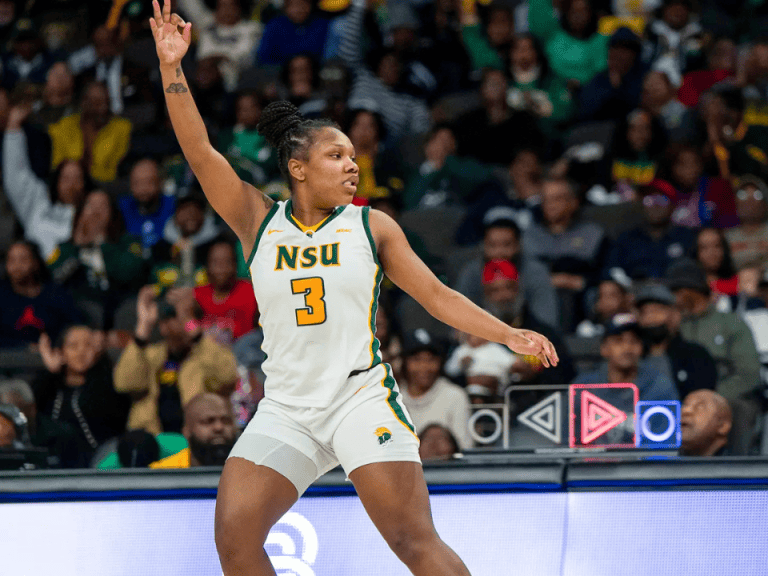
In her professional debut with the upstart women’s basketball league UpShot, former Norfolk State star Diamond Johnson made a great first impression with a dynamic scoring performance.

Playing for the Greensboro Groove on Friday night, Johnson finished with 30 points, including 19 points in the first half, leading her team to a narrow 85-81 win over the Savannah Steel.

The former MEAC Player of the Year was not done piling up buckets, as less than 24 hours later, she would lead the Greensboro Groove to another big win over the Savannah Steel.

She scored 27 points in a double overtime thriller that saw the Groove come away with a 107-105 victory, improving their record to 2-0.


View this post on Instagram


A post shared by Greensboro Groove (@gsogrooveupshot)

Johnson played two historic seasons at Norfolk State, leading the team to a pair of MEAC championships, extending its conference title streak to three years (the first such streak in the MEAC since Hampton won from 2010-2014).

She was named to the All-MEAC team each season, including in 2025 when she won the MEAC Player of the Year award after leading the Spartans to a Division I-high 30 wins.

After going undrafted in the 2025 WNBA Draft, Johnson was signed to the Minnesota Lynx’s training camp roster but was waived after the team’s preseason debut without logging a single minute.

She most recently played with Hefei of the Women’s Chinese Basketball Association (WCBA), averaging 14.7 points and 2.8 steals in 24 games with the team.

The Greensboro Groove is one of four teams starring in the Upshot League’s inaugural season, to provide opportunities for women’s basketball players outside of the WNBA.

Greensboro will be back in action next Friday when they once again face the Savannah Steel at 7:00 p.m. ET, with the game airing live on YouTube.