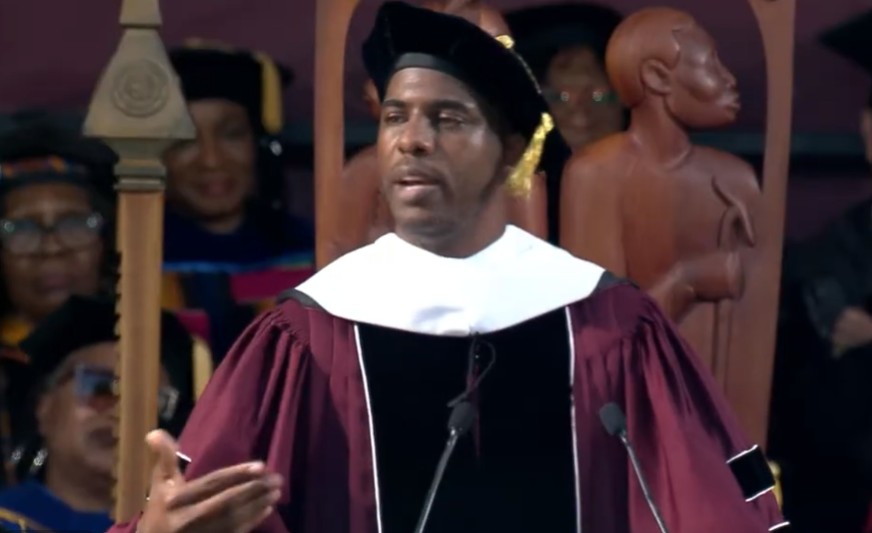
Chris Paul didn’t just show up at Morehouse College to deliver a commencement speech—he showed up to deliver a message rooted in accountability, legacy, and purpose.
Standing before the Class of 2026, the future Hall of Fame point guard immediately set the tone, soaking in the moment and the meaning of the space.
“This is different. This is really different. This is Black excellence,” Paul said, acknowledging the weight of speaking at one of the nation’s most historic HBCUs.
The 12-time NBA All-Star, now stepping into what he described as a “new chapter… beyond basketball,” connected his own journey to the graduates in front of him. Though he began his college career at Wake Forest, Paul proudly reminded the crowd of his HBCU ties to Winston-Salem State, bridging his experience with the brotherhood of Morehouse.
And while he sprinkled humor throughout—joking about his honorary doctorate and insisting on being called “Dr. Paul”—his core message was serious: success isn’t guaranteed, and the degree alone won’t carry you.
“You gotta make this more than just a piece of paper,” he told the graduates. “Who you are, what you value, how you carry yourself… that’s what will make all the difference.”
Lessons from the game—and life
Paul distilled his message into two guiding principles, both shaped long before his NBA stardom.
The first came from his late college coach, Skip Prosser: don’t just be a “3-to-6 guy”—someone who only works when required—be a “6-to-3 guy,” committed to the unseen hours of preparation.
“Do you only put in the work when the lights are bright,” Paul asked, “or are you self-motivated when no one is watching?”
He paired that lesson with a personal story—one of the few times in his career he didn’t start a game. Not because of talent, but because he overslept and showed up late.
That moment, he explained, taught him a defining truth: “Accountability is where everything starts and ends.”
The second principle was bigger than basketball: make the mission bigger than yourself.
Paul reflected on moments of adversity, including being traded without warning and navigating intense leadership scrutiny as president of the NBA Players Association during a turbulent era. Through it all, he emphasized collective purpose over personal pride.
“I don’t know how to be halfway in and halfway out. I’m all in,” he said.
That mindset, he explained, is what allowed him to lead, adapt, and ultimately help secure meaningful progress for players across the league.
A message for Morehouse men
Paul didn’t shy away from the realities awaiting the graduates, particularly as Black men entering professional spaces where they may often stand alone.
“There will be plenty of rooms… where you’re the only person that looks like you,” he said. “My challenge to you is not to build a wall—it’s to build a bigger table.”
It was a line that resonated deeply, tying into both his leadership philosophy and the broader legacy of Morehouse.
He urged the graduates to lean on one another, to value mentorship, and to embrace the responsibility of lifting others as they climb.
“If you are thriving and nobody else around you is,” Paul said, “that ain’t it.”
Despite a decorated 21-year NBA career, Paul acknowledged what many critics often point out—he never won an NBA championship.
View this post on Instagram
But in a moment of clarity and perspective, he reframed that narrative.
“I’ve accepted it,” he said. “Because I gained so much more.”
For Paul, legacy isn’t defined by rings, but by impact—on teammates, on communities, and on future generations.
He shared stories of his father, his late grandfather—who owned a gas station in North Carolina—and Coach Prosser, all of whom shaped his understanding of work ethic, ownership, and accountability.
“Ownership,” he said, echoing his grandfather, “is the difference between waiting for change and becoming the reason change happens.”
Chris Paul delivers final assist
As the speech closed, Paul turned the focus back to the graduates, challenging them directly.
“Are you going to be a 6-to-3 guy? Are you going to make the mission bigger than you? Are you going to inspire us to be what we know we can be?”
For the Morehouse Class of 2026, the message was clear: the degree is just the beginning. The real work—the meaningful work—comes next.