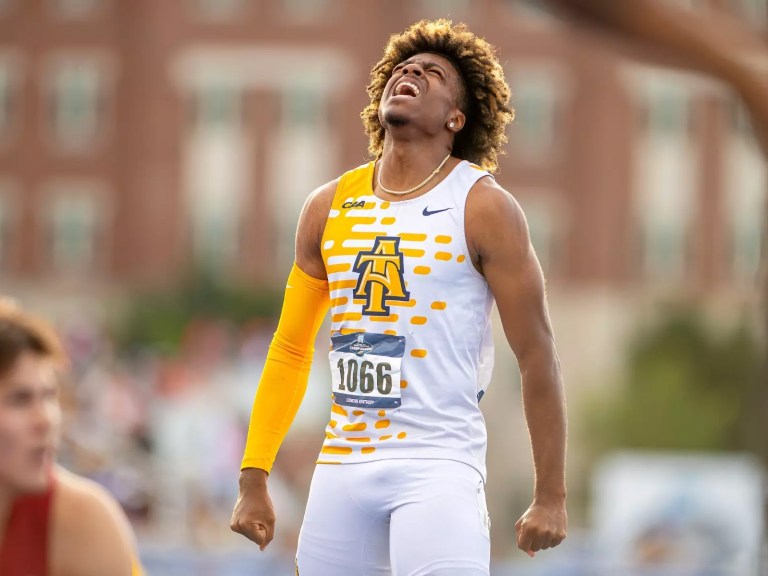
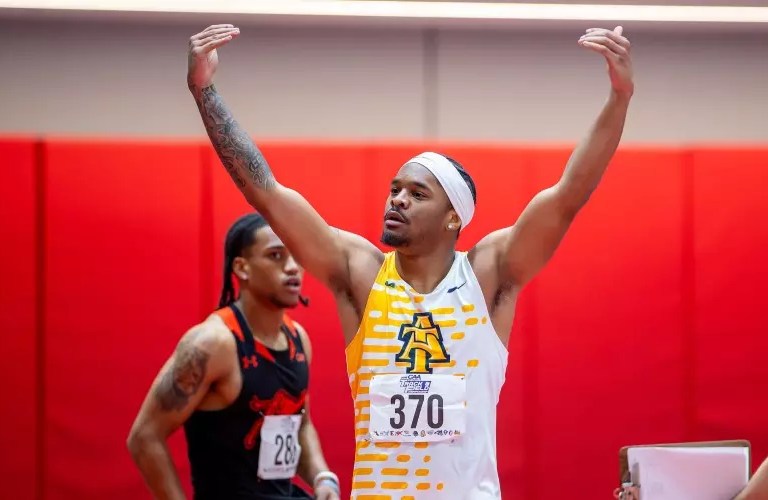
The best performance of the day came from Isaiah Taylor in the 400 hurdles final, claiming third place after crossing the finish line in 49.03 seconds.
This marks the first time a North Carolina A&T athlete has finished in the top three of an event at the Outdoor Championships since Randolph Ross last won the 400m title in 2022 (Javonte Harding also came in third in the 100m final at that year’s championships).
Taylor’s brother, Xzaviah Taylor, finished in seventh place in the 400 hurdle final, clocking in at 49.98 seconds.
In the 110 hurdles final, Jason Holmes recorded a personal-best time of 13.16 seconds, good for fourth place among the championship field.
Meanwhile, the Aggies’ 4×100 and 4×400 relay teams also had noteworthy performances, finishing fourth in the former (38.67 seconds) and sixth in the latter (season-best 3:00.68).
In total, North Carolina A&T’s men ended their 2026 Division I Championship run with 21 total points, tied for 12th in the team standings for the overall event.
However, that will not be the last we will see from North Carolina A&T at the Track & Field Championships as high jumper Spirit Morgan and triple jumper Olivia Dowd will compete on the final day of women’s competition tomorrow evening.
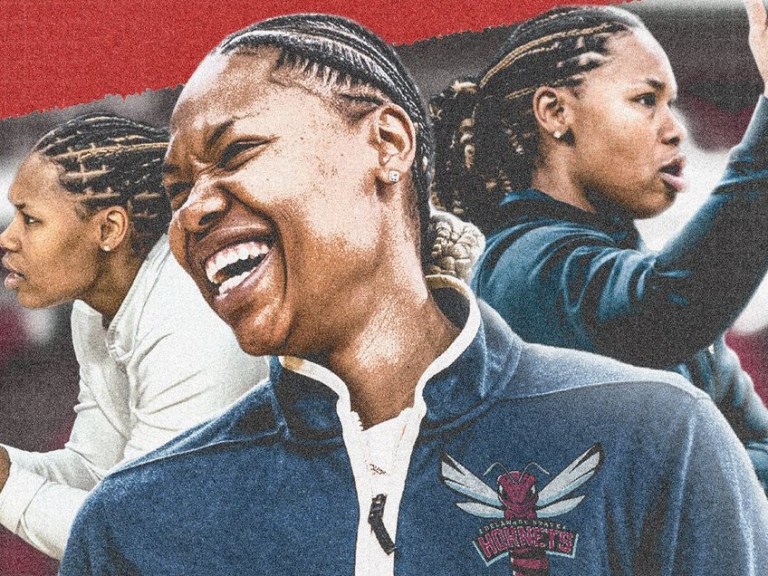
Khadijah Rushdan is ready to take Delaware State back to MEAC contention as their new head coach, and she has a full staff ready to go.
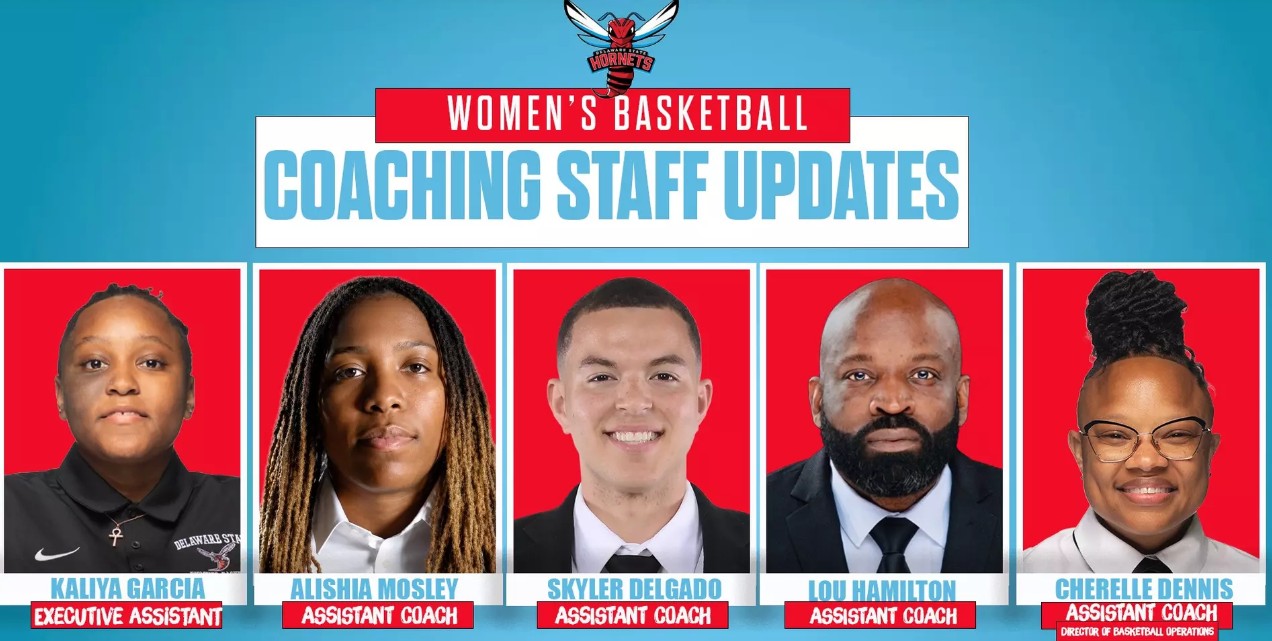
Former Cheyney and Lincoln (Pa.) women’s head coach Alishia Mosley, Cherrelle Dennis, who previously was an assistant coach at DSU, and former Shaw interim head coach Lou Hamilton highlight Rushdan’s staff hires announced by the university Friday.
Joining Mosley, Dennis and Hamilton are Skyler Delgado, a veteran assistant who most recently was a graduate assistant with Providence College’s women’s basketball team after stops with the Oral Roberts men’s program and Division III and JUCO positions in Rhode Island. Kaliya Garcia was also hired as the program’s executive assistant.
Photo: Delaware State Athletics
Mosley served as Lincoln’s interim head coach during the 2025-26 season and previously pulled double duty as athletic director and women’s basketball coach at Cheyney.
Dennis, a former LUPA women’s hoops standout and assistant, worked under both E.C. Hill and Jazmone Turner before stepping away following the 2024-25 season. She will also serve as the Hornets’ director of operations.
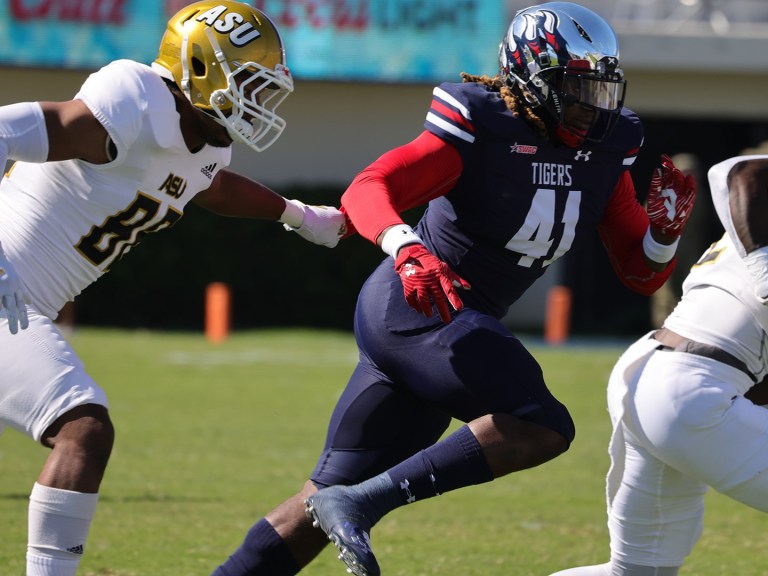
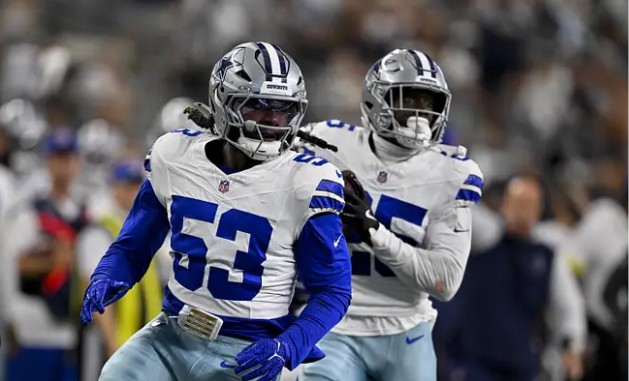
James Houston, the former Jackson State standout, became one of the most impactful additions to the Cowboys’ defense in 2025.
Despite never cracking the starting lineup, Houston carved out a major role as a rotational pass rusher. He finished the season with 5.5 sacks, 35 total tackles, a forced fumble, and a fumble recovery across 17 games. For a player coming off the bench, his production spoke volumes.
That performance didn’t go unnoticed.
Houston was named the NFLPA’s 2026 Black College Football Pro Player of the Year, becoming the tenth NFL player from an HBCU to earn the honor. It’s a recognition that not only highlights his impact on the field, but also his journey from Jackson State to the pro stage.
“Being selected as this year’s NFLPA Black College Football Pro Player of the Year means a lot to me,” Houston said. “My time at Jackson State made me into the man and player I am today, and I’m proud to be a part of the legacy that HBCU players have built and will continue to build on and off the field.”
James Houston is solving problems off the field
Through his Problem Solved Foundation, he continues to invest in the next generation. He has a youth football camp, which is in its third year.
Photo: James Houston
“Me and my team, we got together, and we do a camp every year,” he told the Dallas Cowboys website. “We’re just trying to help the kids — show them how to practice and how to have the right attitude and character to get far in life.”
As part of his NFLPA honor, Houston is also giving back to where it all started. A $5,000 donation has been awarded to Jackson State’s football program.
As on opening day, it was a successful outing for the HBCU competitors, with more punching their tickets to the finals.
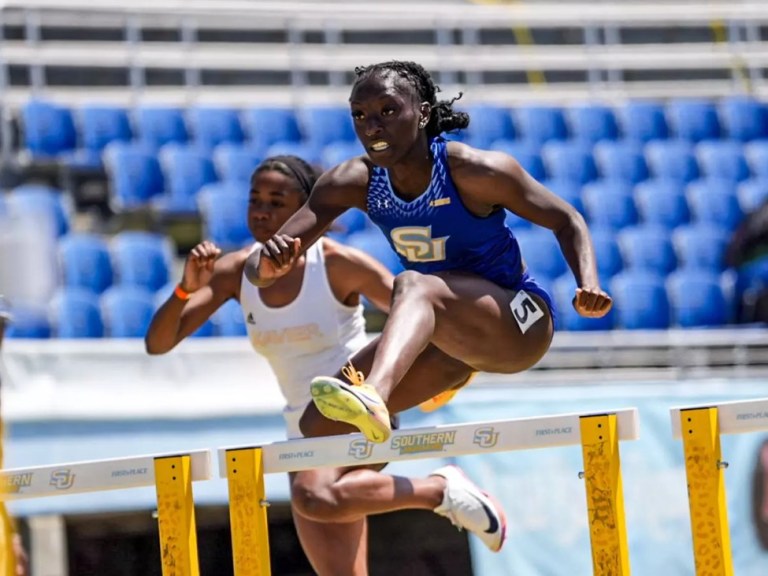
Southern’s Tashina Alase continued her spectacular season by gaining an automatic qualifying spot in the 100 hurdles, winning her heat in 12.90 seconds in a photo finish.
Alase will be joined in the finals by the Howard duo of Cenaiya Billups and Yahnari Lyons, each making it to the championship final in the 400 hurdles and 200m, respectively.
Operating in a fast heat that claimed three of the top four times in the 400 hurdles, Billups clocked in at 55.44 seconds, finishing third in her heat, making her the fastest of the non-automatic qualifiers.
On the other hand, Lyons paced her 200m heat in 22.36 seconds, .02 seconds shy of tying her personal best mark.
The women’s portion of the finals will take place on Saturday.
Joining these qualifiers in the finals are field athletes Olivia Dowd of North Carolina A&T and Daedrian Beville of Alabama State, each competing in the triple jump, while A&T’s Spirit Morgan will compete in the high jump.
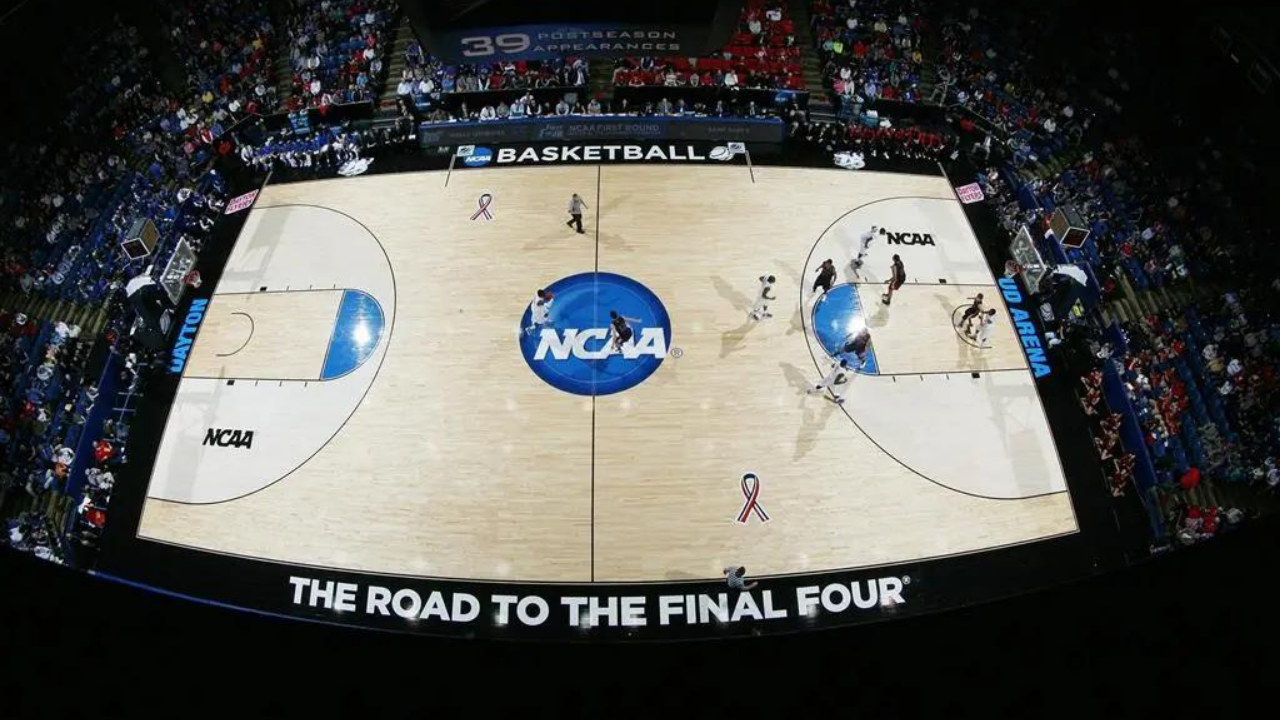
The NCAA’s finding that four former Alabama State men’s basketball players accepted money from gamblers to help throw a game has put a spotlight on how easily college basketball can be compromised when money, access and vulnerability intersect.
Four members of the Hornets’ 2024-25 roster — including NCAA tournament hero Amarr Knox — have been ruled permanently ineligible after they manipulated the outcome of a Dec. 5, 2024, game at Southern Miss. The Golden Eagles, a six-point favorite, won 81-64.
According to NCAA documents, Knox, Shawn Fulcher, Corey Hines and Tony Madlock agreed during a game-day call with bettors to throw the contest. The group received a total of $2,000 — roughly $500 per player — in exchange for influencing the result.
The case came to light months later, after Hines transferred to Temple and was contacted by the FBI about text messages linked to a sports-integrity investigation. Federal prosecutors in Pennsylvania have since indicted two bettors on wire fraud and bribery charges connected to the scheme.
But just how easy is it? And why might athletes — particularly those at smaller schools like Alabama State — fall trap to shady gamblers
It is easy to fix a sporting event
Yet to sports fixing expert and author Brian Tuohy, the Alabama State case is less an outlier and more a warning sign.
“I think it’s very easy to fix a game, especially in college sports,” Tuohy told HBCU Sports. “All you need is access — to a player, a coach, a referee — and a reason.”
Tuohy, who has studied match-fixing and point-shaving cases in the United States and globally, dating back decades, through FBI records, said the mechanics of manipulation are often far simpler than fans assume. It does not require a team to lose outright. In many cases, it involves subtly altering the margin — missing shots, committing turnovers, or allowing a deficit to grow beyond the betting lines, he said.
“A team expected to lose by 10 can lose by 15, and nobody looks twice,” he said. “That’s the kind of thing that flies under the radar.”
Photo: NCAA
The NCAA’s own data suggests the vulnerability is real. In past anonymous surveys of thousands of athletes, roughly 2 to 3 percent reported being approached to influence games — a figure that could translate to hundreds of compromised contests across the college sports landscape.
Despite that, Tuohy argues the larger issue is a lack of consistent oversight.
“The organizations that should be looking for this — the NCAA, leagues, media, even law enforcement — historically haven’t made it a priority,” he said. “If nobody’s really searching for it, it becomes much easier to get away with.”
The NCAA has attempted intervention
The NCAA has expanded its efforts in recent years, monitoring more than 22,000 contests annually and reaching over 500,000 athletes, coaches and administrators through education programs, the collegiate governing body shared with HBCU Sports.
It has also partnered with sports integrity firms, increased social media monitoring, and advocated for restrictions on certain types of bets, including individual player props.
Still, the environment surrounding college athletics has shifted dramatically. A 2023 NCAA survey found 58 percent of young adults aged 18 to 22 had engaged in some form of sports betting, while men’s basketball players reported some of the highest levels of betting-related harassment and pressure.
At the same time, legalization and the rise of mobile betting apps have expanded access to everyone — and, potentially, opportunity to engage in illegal activity.
Photo: Bama State Athletics/X
“Now you can place bets from anywhere, spread money across different states, and it becomes harder to detect unusual patterns,” Tuohy said. “There’s just so much money flowing through the system.”
For smaller programs like Alabama State, that combination can make them vulnerable. NCAA officials acknowledge that bad actors often target athletes at non–Power Four schools, where NIL opportunities may be limited, and games draw less scrutiny.
Basketball players at Coppin State, Mississippi Valley State and North Carolina A&T were also implicated in gambling-related charges by the NCAA.
Alabama State said in a statement it was made aware of the NCAA inquiry into the players’ activity in January. The university said in a statement it was not a party to the case and fully cooperated with the investigation.
“Alabama State University, its athletics program, and its personnel remain committed to integrity and compliance and will continue to operate with transparency,” the school said.
Game fixing is hiding in plain sight
That reality, Tuohy said, makes athletes vulnerable.
“Not every athlete is going to say yes,” he said. “But athletes are human. They face financial pressures, personal issues, and, in some cases, know their careers may not go beyond college. That can make them more susceptible.”
The Alabama State players’ case underscores that tension. For a relatively small payout, four athletes risked — and lost — their collegiate careers, while the integrity of a Division I game was called into question.
For fans, Tuohy believes the takeaway is uncomfortable but necessary.
“Game fixing isn’t just something that happens overseas or in the past,” he said. “It can happen here, and it likely has — more than people realize.”
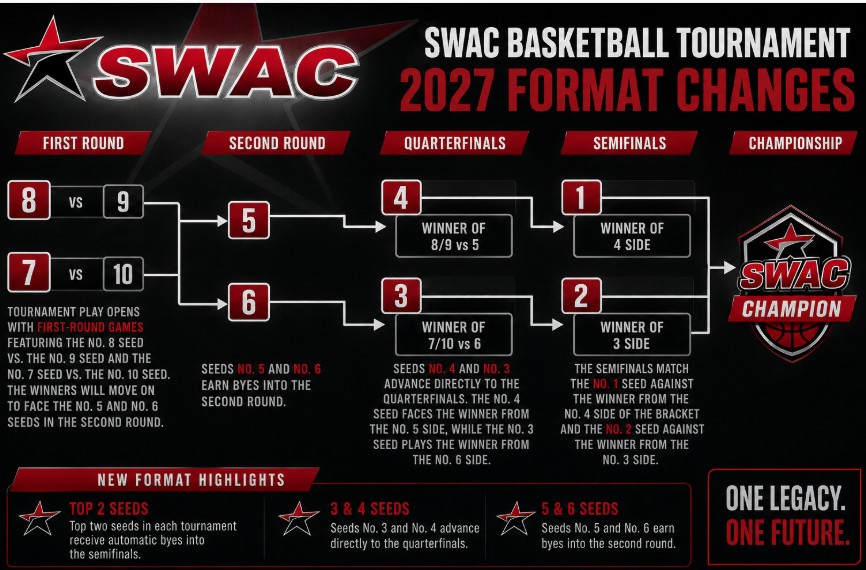
The SWAC will implement a new postseason basketball tournament format beginning with the 2027 men’s and women’s championships, the league announced Thursday.
The revised format, recommended by the SWAC Men’s and Women’s Basketball Working Group, will expand the tournament field to include the conference’s top 10 teams at the conclusion of the regular season.
Under the new structure, the top two seeds in each tournament will receive automatic byes into the semifinal round. Seeds No. 3 and No. 4 will advance directly to the quarterfinals, while seeds No. 5 and No. 6 will earn byes into the second round.
Tournament play will open with first-round games featuring the No. 8 seed against the No. 9 seed and the No. 7 seed against the No. 10 seed. The winners will move on to face the No. 5 and No. 6 seeds in the second round.
In the quarterfinals, the No. 4 seed will face the team that advances from the No. 5 side of the bracket, while the No. 3 seed will play the team emerging from the No. 6 side.
The semifinals will match the No. 1 seed against the winner from the No. 4 side of the bracket and the No. 2 seed against the winner from the No. 3 side.
Conference officials said the working group, which includes league head coaches and administrators, will continue to evaluate the overall viability, growth opportunities, and long-term sustainability of basketball across the SWAC while exploring additional enhancements to the championship experience.
The conference said details regarding tournament dates, game times and ticket information will be announced at a later date.
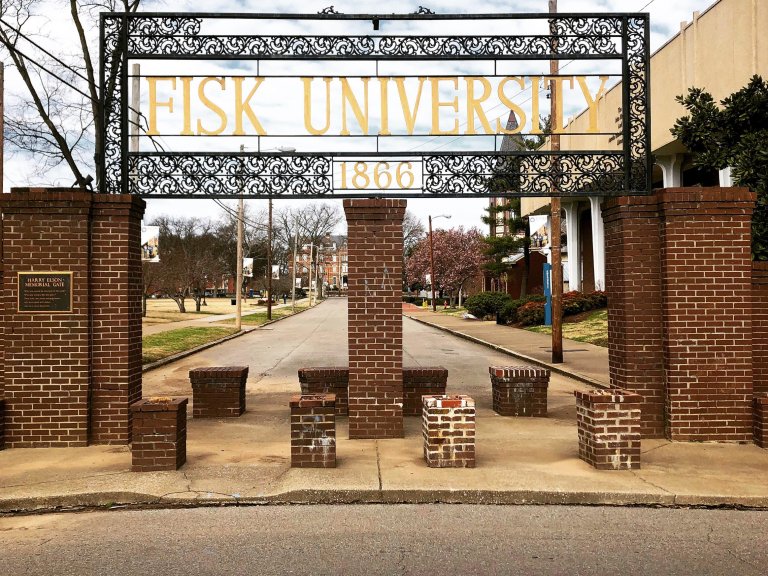
Fisk University is facing pushback over a proposed data center near its main campus.
On Wednesday, protesters opposed a proposed campus Innovation Center that would include a large data center, arguing that the project lacks transparency and could cause environmental harm to Black students at Fisk and Nashville residents.
The demonstration took place at the university gates as critics, including state Rep. Justin Jones, D-Nashville, called on Fisk to release more information about the plan, which is part of the school’s $1 billion Quantum Leap campus master plan.
Jones, a Fisk graduate, said the school should be guided by the legacy of John Lewis, another Fisk alum known for urging people to get into “good trouble.”
“We’re here to get in the way of a project that we know will be detrimental not only to our Fisk campus, but to the surrounding community,” Jones said at a press conference.
Data center ‘preying on our HBCU’
Jones said the proposed $400 million, 100,000-square-foot Innovation Center featuring a 30-megawatt data center would sit near public housing, a high school and Fisk student dormitories, and he argued that such facilities tend to land in Black, brown and low-income communities.
“If this project was so amazing, as they said, for universities, it would be at Vanderbilt,” Jones said. “But instead they’re coming to Fisk University, using this tactic of extraction and preying on our HBCU.”
The project is part of Fisk’s broader Quantum Leap plan. University officials have described it as an innovation and technology center that would support academic growth and workforce development, but critics say the proposal is really a data center with a thin academic wrapper.
Winston Wellington Wright, a Fisk and Morehouse School of Medicine graduate who helped launch an online petition against the project, said the petition has already drawn more than 6,000 signatures.
“We are standing in a zip code that consistently ranks within the top three for the highest rates of asthma prevalence in emergency department-related visits across the city,” Wright said. “Data centers built for AI are threats to our public health and quality of life.”
Photo: Fisk University
In a passionate appeal, Fisk student Eriqua Martin said the university’s campus is “sacred ground” and should not be treated like available land for corporate development.
“This campus is not just property,” Martin said. “It is not raw acreage waiting to be leveraged.”
Martin said university leaders have promoted the project as progress, but she said the community sees it differently.
“True progress can never be bought at the expense of our people, our culture and our environment,” she said.
Timothy Hughes, president of the Nashville NAACP and chair of community engagement for the National Fisk University Alumni Association, said the concern is not anti-technology. He said the issue is whether Fisk can move forward responsibly while protecting neighbors and students.
“These conversations are not anti-technology,” Hughes said. “They are about ensuring the growth that occurs responsibly, transparently, and with meaningful public participation.”
Fisk says project will do ‘no harm’ to community
Other speakers echoed concerns about pollution, energy use, water demand and the burden on North Nashville’s infrastructure. Jared Harper, another Fisk graduate, said data centers can drive up utility costs and bring diesel pollution, while Karen Johnson, a longtime local elected official, said residents learned about the proposal through the media rather than through community meetings.
At the end of the event, organizers said they want a town hall, fuller disclosure about corporate partners and a community benefits agreement before the university moves forward.
Fisk officials have said the project is being developed under a “do no harm” philosophy, but opponents say they are still waiting for answers.
For now, the debate has become about more than a building. It is about who gets a say in the future of one of the nation’s oldest HBCUs — and whether North Nashville will once again bear the cost of someone else’s vision.
In the first championship event on the track, North Carolina A&T’s men’s 4×100 relay team advanced to the finals in a season-best 38.53 seconds.
They then ended the night by advancing to the finals of the men’s 4×400 relay, earning an automatic qualifier after finishing second in their heat in 3:02.19.
This marks the first time North Carolina A&T will compete in the finals of the 4×100 and 4×400 relay in the same year since 2022.
In addition to their relay teams having strong semifinal performances, a trio of athletes followed suit, punching their ticket to the finals.
Jason Holmes put forth a career performance in the men’s 110 hurdles, recording a personal best 13.17-second time to win his heat and claim the coveted automatic bid.
Taylor twins make NCAA finals
Then, in the men’s 400 hurdles, brothers Isaiah and Xzaviah Taylor each snagged automatic finals bids, finishing second in their respective heats in times of 49.00 and 49.28 seconds.
Bethune-Cookman’s football program celebrated another milestone this past weekend when Wildcat safety-turned-Super Bowl champion Nick Collins was inducted into the Black College Football Hall of Fame.
When the great HBCU football teams are mentioned, Bethune-Cookman deserves a lot more love.
While not as glamorous as their SWAC counterparts at Grambling, Jackson State, Southern, or even in-state rival Florida A&M, the Wildcats have enjoyed several different eras of success at mostly every level of college football.
Which begs the question: is Bethune-Cookman HBCU football’s most underrated legacy program? They have a strong case.
Early Wildcat success
Bethune-Cookman’s first taste of success came in the Southeastern Athletic Conference, a competitor of the Southern Intercollegiate Athletic Conference.
Under coaches Preston Peterson and Bunky Matthews, the Wildcats won SEAC championships in 1942 and 1947 before leaving to join the SIAC in the early 1950s.
Matthews coached at BCU for 15 years, winning the SIAC title in 1952 as well as the Flower Bowl (1948), the Steel Bowl (1951) and the Tropical Bowl (1952).
Following Matthews’ retirement, a former player of his would retire from the NFL and become one of the pivotal figures in HBCU football and sports history.
The Cy McClairen Era
Jack Forsyth McClairen played six seasons with the Pittsburgh Steelers before returning to Daytona Beach to serve as football coach, men’s basketball coach and athletic director.
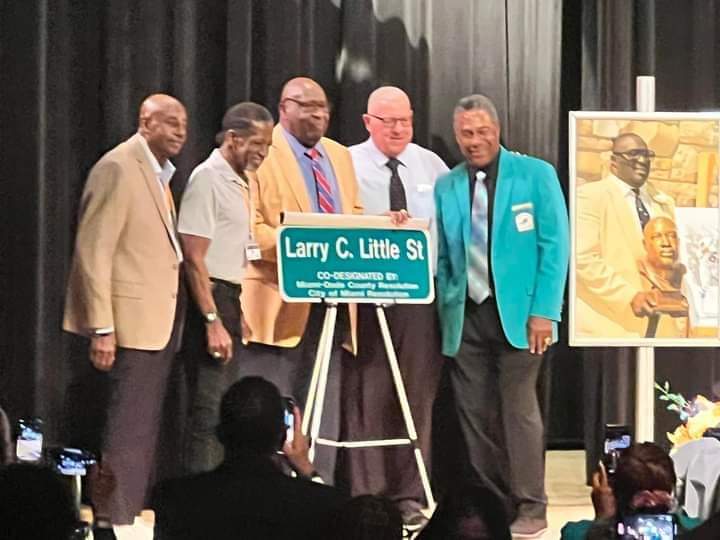
One of Cy’s most famous pupils was an offensive lineman from Miami named Larry Little. Little blossomed under McClairen and Tank Johnson’s tutelage, earning all-SIAC honors three times.
Little went on to become a powerhouse blocker for the Miami Dolphins’ back-to-back Super Bowl championship teams in 1972 and 1973 and would get into coaching himself.
Photo: Bethune Cookman Athletics/Twitter
Another football player who would figure prominently in BCU’s football future was a speedy defensive back/kick return specialist from Jacksonville named Alvin Wyatt.
After McClairen stepped away from the football team following the 1972 season, Charles W. Moore took over for a brief three-season tenure and won the SIAC twice (1973 and 1975) as well as the 1974 Azalea Bowl.
Andy Hinson was next up, winning the SIAC in 1976 and leading Bethune to their first NCAA playoff appearance in 1977, a 31-16 loss to UC-Davis in the round of the Division II tournament.
The Wildcats joined the MEAC and Division I in 1980 and experienced growing pains until Larry Little returned in 1983 to lead the program.
After a 4-4-1 season that first year, Bethune-Cookman took the MEAC by storm in ‘84, finishing with a perfect 4-0 conference record and 7-3 overall, winning its first MEAC title and first conference title of any kind in eight seasons.
That would be the bulk of BCU’s success under Little, and even the return of Cy McClairen in the mid-90s couldn’t revive the program.
Enter, or re-enter, Alvin Wyatt.
Wildcats “Shine” under Wyatt
Following a five-year career as a return specialist in the NFL and the now-defunct World Football League, Wyatt served as an assistant coach at Bethune for 21 seasons – under Hinson, Bobby Frazier, Little and McClairen.
Alvin Wyatt
The man who would become known as “Shine” made the most of his opportunity.
Step One was installing the “Wyattbone” offense, a triple-option attack that thrived on athleticism, strategy, and the ability to confuse defenses.
Step Two was…well, being “Shine.” Whereas most coaches of the era preferred golf shirts and khaki pants in university colors, Wyatt dressed as if he were performing on the Tom Joyner Fantastic Voyage cruise.
The coach may have been cool, the Wildcats under Wyatt played tough, physical football, winning the MEAC in 2002 and making FCS playoff appearances in ‘02 and 2003. Among his players to make it to the NFL were hard-hitting safeties Nick Collins and Rashean Mathis and return specialist Eric Weems.
Brian Jenkins keeps the magic going
By the beginning of the 2010s, a new leader was in charge at BCU. Former Cincinnati wide receiver and offensive assistant coach Brian Jenkins installed a high-powered attack that terrorized MEAC teams for five seasons.
Jenkins’ Wildcats won a share of the MEAC five times, making FCS playoff appearances in 2010, 2012 and 2013.
Bethune-Cookman won a share of their last MEAC title under Terry Sims in 2015 and have been trying to get back into the championship chase since joining the SWAC in 2021.
Can Bethune-Cookman return to championship form?
Another former Wildcat player, Raymond Woodie Jr., now leads the program, and after a surprising 6-6 season in 2025, BCU is looking to make noise in the SWAC Eastern Division, which features Jackson State and Alabama State.
If there’s anything the history of Bethune-Cookman football can tell us, it’s that nothing is impossible for the school Mary McLeod Bethune started more than 100 years ago.
Every so often, a dynasty out of Daytona Beach pops up and succeeds when everything points to it being a surprise.
The MEAC is heading back to the big stage — and bringing some major media star power with it.
The conference announced that its 2026 Football Media Day will once again take place at M&T Bank Stadium, home of the Baltimore Ravens, on Tuesday, July 21. After a successful run there last year, the MEAC is doubling down on the NFL setting as it continues to elevate its preseason showcase.
But this year comes with an added twist.
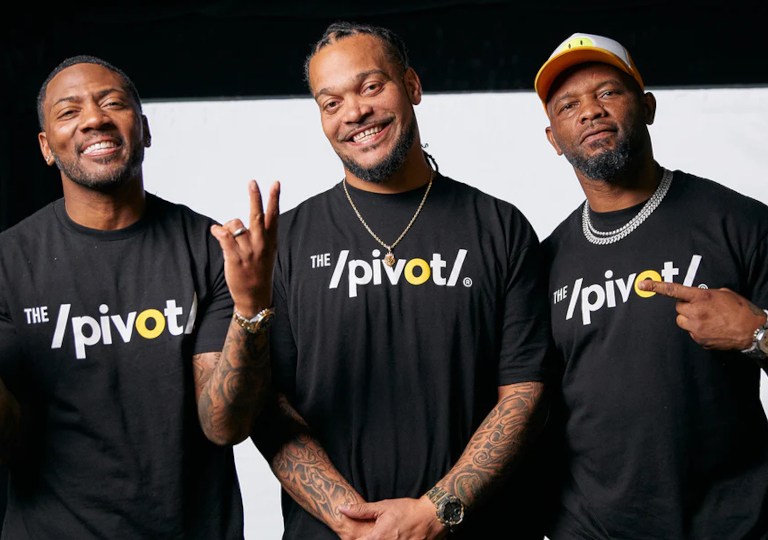
“The Pivot,” one of the most influential sports podcasts in the country, is set to be part of the event. Hosted by former NFL standouts Ryan Clark, Channing Crowder, and Fred Taylor, the show’s presence adds a new layer of visibility and storytelling to an already high-profile day.
“It is a tremendous honor to return to M&T Bank Stadium… and to be joined by The Pivot,” MEAC Commissioner Sonja Stills said. She also credited Ravens President Sashi Brown for helping make the opportunity possible, while pointing to the continued partnership between the NFL and HBCU conferences as a key driver in the league’s growth.
Photo: MEAC
Ravens President Sashi Brown didn’t shy away from that significance.
“A cornerstone of Black collegiate athletics, the MEAC’s eight HBCU programs represent their communities with outstanding pride, excellence and purpose,” Brown said.
And from the league office, there’s a clear understanding of the bigger picture.
NFL Executive Vice President Troy Vincent framed the event as more than just a preseason talking point, emphasizing its role in celebrating student-athletes while preparing them for life beyond football.
At its core, MEAC Football Media Day continues to evolve.
It’s still about hearing from coaches, meeting the players, and setting the tone for the season. But now, it’s also about visibility, access, and storytelling on a much larger scale.
And with “The Pivot” in the building this year, don’t be surprised if a few must-watch moments come out of Baltimore before the first kickoff of the season.