

Two current HBCU basketball players and four others are in hot water with the federal government on gambling-related charges.
Camian Shell of Delaware State and Texas Southern’s Oumar Koureissi are implicated in a far-reaching indictment involving players from various schools, including former athletes at North Carolina A&T, Alabama State, and Coppin State.
The Alabama State players identified were Amarr Knox, Shawn Fulcher, Corey Hines, and Tony Madlock, all of whom are no longer on the team.
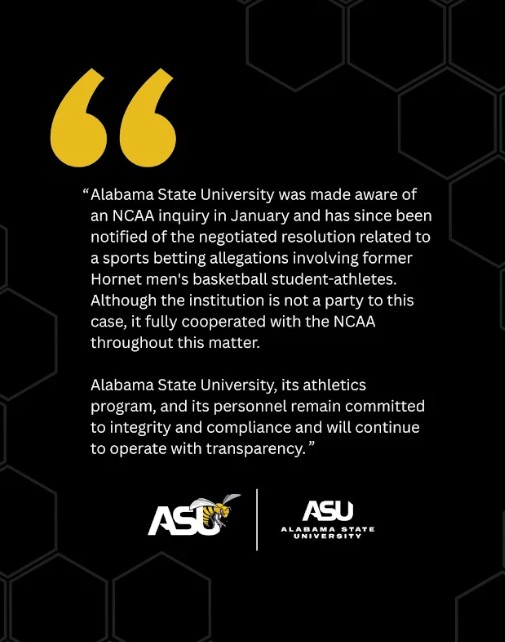
The charges, according to a report from The Athletic, stem from “an alleged conspiracy to bribe and manipulate college basketball games involving then-active college athletes.”
Alabama State players offered money to throw games
An NCAA investigation revealed that a bettor offered Alabama State money to throw its December 2024 game against Southern Mississippi the next night. Knox’s teammates, including Fulcher, Hines and Madlock, then participated in a FaceTime call with the bettor the morning of the game in which Madlock told the bettor he was injured and was not going to play that night. The group agreed on the call to throw the game.
“Knox reported that he, Fulcher, Hines and Madlock received a total of $2,000 from the second known bettor for throwing the game against Southern Mississippi,” according to the NCAA report.
U.S. Attorney for the Eastern District of Pennsylvania David Metcalf said, “This is a prosecution of the criminal corruption of college athletics.”
The NCAA indicated that the athletes are permanently ineligible to compete.
NCAA investigation tied to ex-NBA player
According to the charges, former LSU/NBA player Antonio Blakeney and two other men, Shane Hennen and Marves Fairley, “recruited college players with bribes and then asked them to help fix games so their teams would not cover the spread — the number of points by which a sportsbook predicted a team would lose its game. The players, prosecutors say, were offered between $10,000 and $30,000 for each game to be a part of their gambling ring.”
The charges are a part of an investigation that dates back to last fall, when several players were implicated in a scheme that included “betting against their own team, game manipulation and sharing information with third parties for gambling purposes.”
Student-athletes who are found to have violated NCAA rules are ineligible and can be reinstated only with the assistance of an NCAA school.