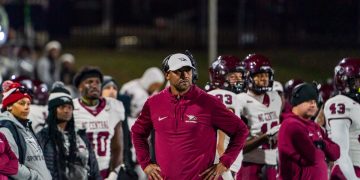


North Carolina A&T football coach Shawn Gibbs voiced measured support for a proposed NCAA reform tied to a recent executive order by President Donald Trump that would impact athlete eligibility and the transfer portal.
Gibbs said he favors maintaining athlete mobility but believes tighter controls could help stabilize college rosters and promote long-term development.
“I kind of like the executive order, as far as kids still having the freedom to transfer, but just one time,” Gibbs said Thursday on the Aggie Pridecast with Brian Holloway in response to a question about the executive order. “After that, you’d have to sit out a year, which I think would kind of cut back on things.”
The proposal comes amid ongoing debate around the transfer portal and its impact on roster continuity across college athletics. Programs at every level, including HBCUs, have seen increased player movement in recent years.
President Trump signed an executive order earlier this month under his “Save College Sports” initative that would limit how long college athletes can compete and restrict how often they can transfer schools.
The order mandates the NCAA to create rules that say college athletes can play for “no more than a five-year period” and allows them to transfer schools only once before they graduate without having to sit out a season.
Athletes currently can enter the transfer portal without restriction.
Frequent transfers compromise student-athlete model
NCAA President Charlie Baker recently said Trump want to “get something on the books that works and represents what most people are looking for at this point, which is a much simpler eligibility process, which we’ve been talking to our committees about.”
Gibbs, in his second season as NC A&T coach, acknowledged the complexity of the issue, noting that no single solution will satisfy all stakeholders.
“There’s really no right way to do it,” he said. “Anything that we do, somebody is going to complain about it. It’s not going to fit somebody. So I just take the approach that it is what it is. Whatever comes down, we’re just going to adjust to it and do the best that we can.”
While supportive of giving players opportunities to find the right fit, Gibbs pushed back on the growing trend of frequent transfers.
“I want guys to have the freedom to find a place that’s right for them,” he said. “But I don’t think the answer is to go to four or five schools. I don’t think the answer is to become a mercenary for hire where you’re at a different school each year.”
Shawn Gibbs says colleges provide athletes community
Gibbs emphasized the long-term implications for players beyond their college careers, particularly for those who do not reach the NFL.
“We have to start really thinking about life after football,” he said. “It’s not about what you know, it’s who knows you. If you don’t stay at a place but one year, who’s going to know you?”
He added that increased stability could help athletes build stronger relationships and networks that extend beyond the field.

“You went to four different schools, and you played pretty good, and let’s say the NFL doesn’t work out — now what?” Gibbs said. “That’s not good for anybody.”
Gibbs believes measures that encourage players to remain at one program longer could ultimately benefit both athletes and teams.
“Getting a little bit of a handle on it and kind of forcing young men to stay in a place a little longer, I think, is going to benefit everyone,” he said.