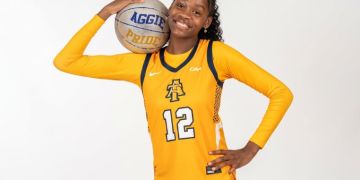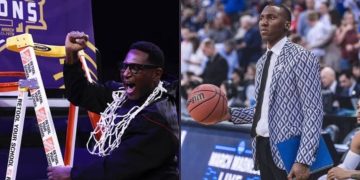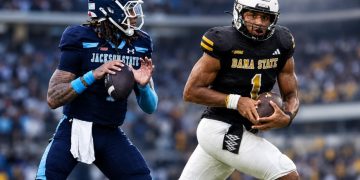

The NAACP’s recent call for Black student-athletes to consider where they play collegiate sports has put HBCUs — fair or not — in a political tug-of-war.
Earlier this week, the organization announced the “Out Of Bounds” campaign, which calls for Black student-athletes and stakeholders to withdraw financial support from public universities in states that have moved to limit, weaken, or erase Black voting representation.
The push follows a U.S. Supreme Court decision that struck down Louisiana’s congressional map as an unconstitutional racial gerrymander, a ruling civil rights advocates say weakens protections for Black voters.
The campaign is targeting flagship public institutions in South Carolina, Georgia, Mississippi, Louisiana, Texas, Florida, Tennessee and Alabama.
“The NAACP will not watch the same institutions that depend on Black athletic prowess to fill their stadiums and their bank accounts remain silent while their states strip Black communities of their voice,” NAACP CEO and president Derrick Johnson said in the organization’s statement.
The campaign also calls to action Black athletes to make three considerations, including:
- Black athletes and recruits are asked to withhold commitments from targeted programs, to ask coaches and athletic directors about their universities’ positions on voting rights, and to visit and seriously consider HBCUs.
- Current college athletes are asked to use their platforms to elevate the issue, to ask institutional leadership for public statements opposing racial vote dilution, and to consider all available options under the transfer portal.
- Fans, alumni, donors, and consumers are asked to stop purchasing tickets, merchandise, and licensed apparel from targeted programs and to redirect that spending to HBCUs — their athletics programs, scholarship funds, NIL collectives, bands, and alumni foundations.
A call for politicial leverage — and limits
At Prairie View A&M, football coach Tremaine Jackson said the idea of athletes using their influence to drive change is welcome—but expecting widespread buy-in without structural investment is unlikely to result in a sustained movement.
“I think it’s good that we teach our young people the influence and the power that their decisions have,” Jackson told HBCU Sports. “But don’t ask those kids to make that kind of sacrifice if you’re not willing to invest in the places you’re asking them to go.”
A report by Inside Higher Ed, using federal data on state spending from 1987 to 2020, found that 16 of the country’s 19 historically Black land-grant universities were underfunded by their states by $13 billion.
Jackson, who is in his second season at Prairie View after leading the Panthers to a SWAC championship in 2025, pointed to the widening financial gap between Power Four programs and HBCUs, particularly in the era of name, image and likeness (NIL) compensation and revenue sharing.
He noted that elite recruits often face choices between six-figure NIL deals at major programs and far smaller opportunities at HBCUs.
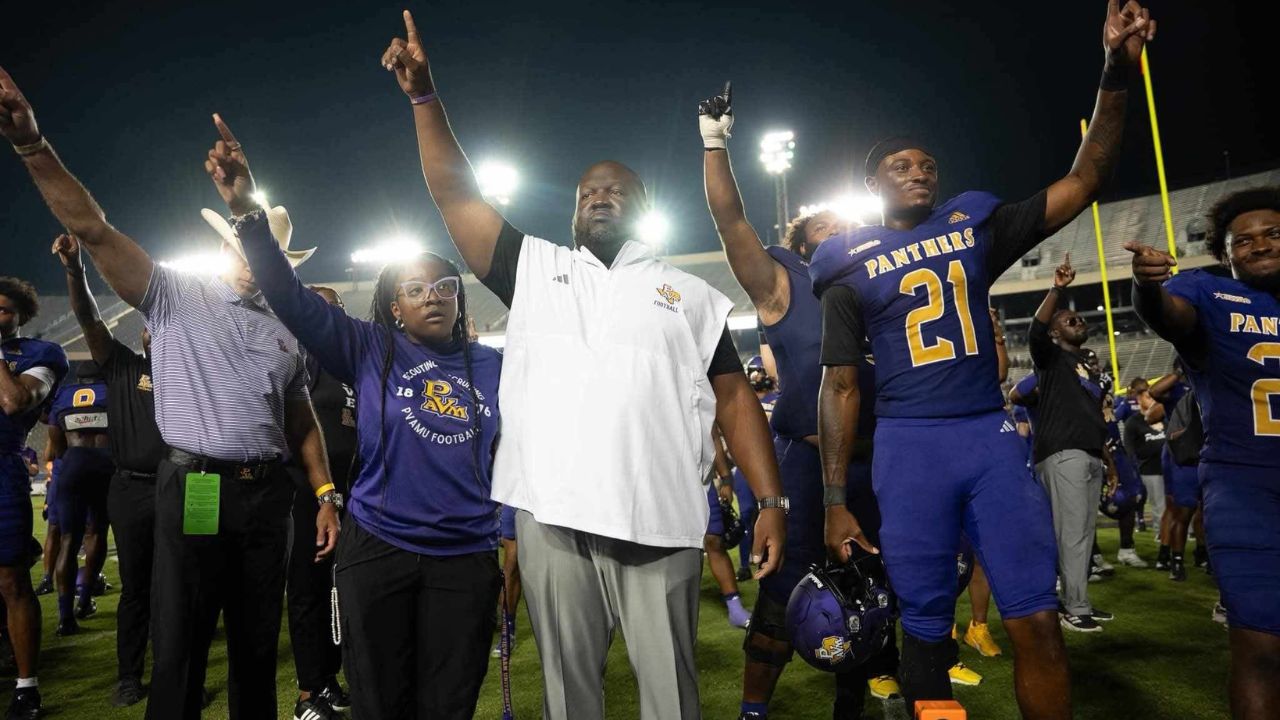
Jackson has previously been candid that Prairie View can’t offer NIL deals comparable to those at in-state Power 4 schools like Texas or Texas A&M, or at nearby Houston, which can offer athletes millions to compete.
That was underscored by Panthers men’s basketball coach Byron Smith, who revealed during the program’s NCAA Tournament run that “We’re not paying one player on our team.”
“In recruiting, kids are asking: How much am I getting paid? What does the facility look like? What are my opportunities?” Jackson said. “If LSU is offering $275,000 and an HBCU can offer a fraction of that, it’s hard to expect an 18-year-old—and their family—to turn that down.”
Jackson added that while the NAACP campaign is worthy of spotlighting long-standing inequities that impact Black citizens, many recruits are likely disengaged from the political issues driving it.
“A lot of kids we recruit aren’t even registered to vote,” he said. “If it’s not in front of them every day, they’re not focused on gerrymandering or legislation. They’re focused on their immediate future.”
True HBCU investment versus idealism
The Prairie View coach was blunt about what he believes would need to happen for a true shift toward HBCUs.
“If lawmakers believe in this, then go first,” Jackson said. “Invest real money into HBCU athletics—facilities, staffing, nutrition, NIL—so these schools can match the experience. Then the kids will come.”
Without that commitment, he warned, the burden falls unfairly on athletes.
“It’s easy to ask a kid to give something up when you’re not giving anything up,” he said. “That’s not fair.”
Jackson suggested it would require a near-universal movement among elite athletes to disrupt the current power structure.
At Alabama State, athletics director Dr. Jason Cable sees the moment differently. He views it as a chance for schools to elevate the HBCU experience.
“I’m a proponent of student-athletes coming to HBCUs,” Cable said. “If this becomes a motivator, then so be it. But the most important factor is making sure people understand the value we provide.”
Cable emphasized that HBCUs have long been intertwined with social movements, noting Alabama State’s role in the Civil Rights Movement and that its campus was a hub for planning the Montgomery Bus Boycott.

That history, he said, makes it difficult to separate athletics from broader societal issues.
“HBCUs have always been a focal point in movements involving African-American rights,” he said. “That connection isn’t new.”
Cable also pushed back on the notion that HBCUs cannot offer high-level athletic experiences like blueblood schools if all of a sudden Black colleges became a destination.
“We don’t have horrible facilities. That’s a false narrative,” he said about a school that’s produced professional sports talent. “Our resources may be smaller in scale, but that doesn’t mean the experience is less than.”
In 2012, Alabama State opened a $62 million football stadium. The array of athletic facilities also includes a $7 million weight room.
How to put recruiting realities and movement into perspective
Still, Cable acknowledged the financial realities shaping modern recruiting. Power conference schools, bolstered by NIL collectives and revenue-sharing models, often have a built-in advantage.
Rather than leaning into political messaging on the recruiting trail, Cable said Alabama State will continue to focus on its core pitch.
“We approach it the same way—we believe what we offer is enough,” he said. “If other factors influence decisions, that’s up to the individual.”
Overall, the NAACP’s campaign has drawn support from some lawmakers and activists who see college athletics as a powerful economic engine capable of possibly influencing policy.
College athletes have led campaigns in recent years, using their platforms to push for social change. In 2015, Missouri football players
In 2015, a group of Black players on the Missouri football team proclaimed they would stop participating in football activities until university system president Tim Wolfe resigned over how he handled reported racial incidents on campus.
Former Mississippi State running back Kylin Hill said he wouldn’t play for the Bulldogs until the state flag was changed.
But as both Jackson and Cable suggest, translating that leverage into a sustained movement toward HBCUs will require more than messaging.
It will demand alignment between political advocacy, institutional investment, and the personal realities facing athletes and their families.
Whether the overtures spark a meaningful shift or become another moment in the history of sports-driven protest may ultimately depend on who is willing to act first—and what they are willing to put on the line.