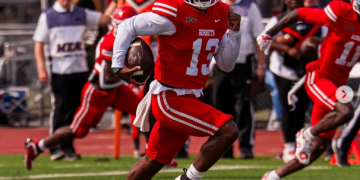


Florida A&M University’s football team will be ineligible for postseason play in 2026 following Level Two Academic Progress Rate penalties issued by the NCAA, the school announced Friday.
The penalties stem from deficiencies in academic infrastructure, according to school President Marva B. Johnson, who said she pledged to strengthen institutional support moving forward.
“Florida A&M holds its student-athletes to the same standard of excellence we hold every Rattler,” Johnson said in a statement. “These penalties reflect a failure of institutional infrastructure, not a failure of our student-athletes. We are committed to building the academic support structure this program has long deserved — and this administration will be accountable for delivering it.”
The NCAA determined FAMU’s four-year rolling APR score fell below the required 930 benchmark, resulting in the postseason ban.
The APR measures academic eligibility and retention among scholarship student-athletes and is calculated across a four-year average. The data used includes academic years prior to Johnson’s tenure and to the current athletic leadership and football coaching staff being in place.
FAMU had hoped NCAA waiver would help
Director of Athletics John F. Davis said the university accepts the NCAA’s findings and has begun implementing an enhanced academic action plan to correct structural weaknesses.
“We owe it to our student-athletes and the Rattler community to be transparent about where we are and where we are going,” Davis said. “The four-year rolling average that produced this outcome includes a period of significant transition — that context does not excuse the result. We are here to fix it.”
FAMU had hoped a conditional NCAA waiver used during the 2025 season would prevent further penalties, but its requirements were not met, triggering next season’s postseason restriction, he said.
School, team will be accountable
First-year head coach Quinn Gray Sr. said academic accountability remains central to his program, even amid the restrictions.
“Academics and football are not competing priorities in our program — they are the same priority,” Gray said. “We’ve put systems in place for execution and accountability every day. This ban doesn’t stop us from impacting lives or building toward our ultimate goal of earning degrees.”
The university has launched several steps to improve academic outcomes, including expanded compliance oversight, real-time academic tracking, and new protocols for early identification of at-risk student-athletes.
The Rattlers will still play a full regular schedule in 2026, beginning Aug. 29 at home against Albany State and ending Nov. 21 in the Florida Blue Florida Classic against Bethune-Cookman.