The SWAC basketball season may have ended on the court, but the sideline game of musical chairs has just begun.
With Tony Madlock resigning from Alabama State, Mo Williams leaving Jackson State, and now Johnny Jones departing Texas Southern, three prime head coaching positions are available on the men’s basketball side.
The intrigue goes beyond just a simple opening of a Division I men’s basketball coaching opportunity, but also where these departed coaches are heading and the positions they are taking.
Williams is following his son, Mason, to Kentucky as an assistant coach, Madlock returns to Memphis to assist Penny Hardaway once again, and Jones, a member of LSU’s 1981 Final Four team and former Tigers head coach, returns to Baton Rouge alongside new (again) head coach Will Wade.
Yes, three men who were head coaches at HBCUs left to be assistants at PWIs on the Power 4 level. That is not an indictment of SWAC or HBCU basketball.
It proves that our schools are a hot commodity, even if these partnerships with name-brand coaches don’t last. It also just comes with this new territory of player and coach empowerment at the collegiate level.
Change in college basketball coaching is inevitable
The first thing we have to admit is that the days of four-year players playing for coaches who have been at a school for 20 to 25 years are effectively over. That is not just an HBCU reality; it is everyone’s reality.
North Carolina fired Hubert Davis less than five years after he ended Mike Krzyzewski’s run at Duke in the Final Four, and the guy who just won the national championship, Michigan’s Dusty May, was in the running until this past weekend to take his place.
The sooner we realize college sports are now a transient entity, the quicker HBCUs can adjust. Part of that process is identifying young coaching talent that can improve a program quickly and leave it in good hands for the next person.
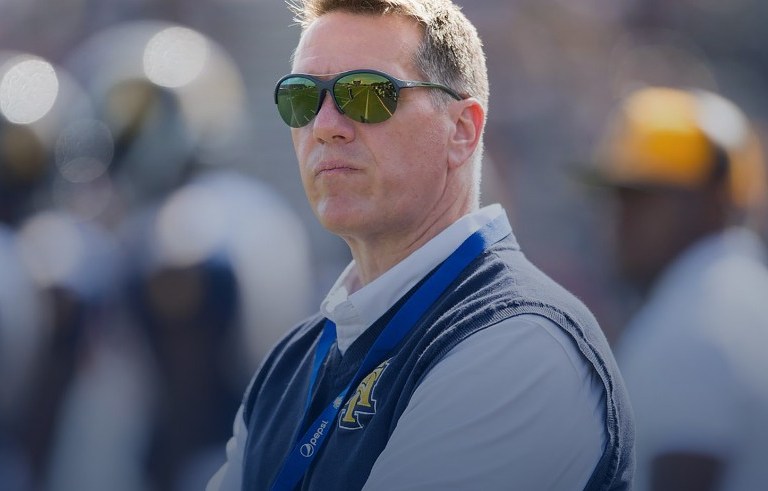
Photo: Alabama State Athletics
Younger coaches relate to players better because they were not that far removed from being in their players’ shoes, and they also have the energy to research and master the new era of college sports.
Older guys like Jones and Madlock probably feel better serving as assistants without the head coaching responsibility. Williams (who is actually a year younger than me, damn) likely sees a way into a Power 4 job by assisting Mark Pope and having his son play for Kentucky in the process.
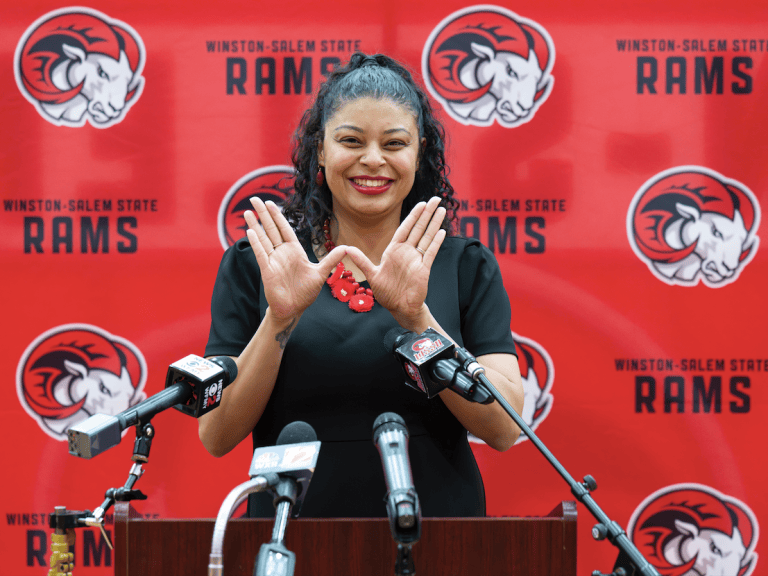
Once younger coaches are installed, give them room and the resources to run a program. When you have university support, such as the case for Winston-Salem State women’s coach Tierra Terry, wonderful things can happen. When you don’t have the support (see Delaware State and Jazmone Turner), bad things often happen.
That is why no one should lose sleep over three coaches moving on from the SWAC to the Power 4 level. The key is to build resources so the next coach can shine, and if they choose to leave, the program remains successful.
It can be done. It’s just up to HBCU administrations to see it through.
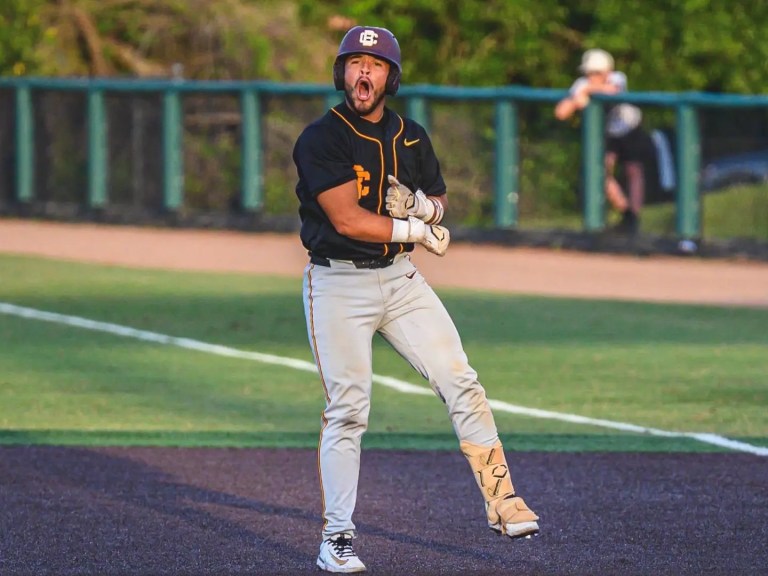
The defending SWAC champions upset No. 24 LSU 10-7 at Alex Box Stadium for the Wildcats’ first win over a ranked opponent since 2017.
Bethune-Cookman jumped on LSU from the start
The Wildcats set the tone early and never fully let LSU settle in. Bethune-Cookman scored in the first three innings, then broke the game open in the third, building a 6-0 lead.
Erick Almonte drove in a run with a sacrifice fly in the first inning, Sergio Rivera later scored on a catcher’s error in the second, and Jeter Polledo, Christopher Watson, and Almonte all added RBI in the third.
That early pressure forced LSU to play catch-up the rest of the night.
Christopher Watson powered the Wildcats’ offense with a double, two home runs and four RBI in the earlier Southern series, and Bethune-Cookman carried that momentum into the LSU game. Michael Rodriguez entered the night on a four-game hitting streak, while Andrey Martinez had hit safely in five straight and produced eight hits, two homers and five RBI over that stretch.
Bethune-Cookman also got another strong start from Justin Morales, who came in 2-1 with a 1.13 ERA and had not allowed an earned run in five straight outings. The Wildcats’ ability to get early offense and steady pitching proved enough to finish the upset.
Bullpen shuts down LSU rally attempt
LSU answered late but could never completely erase the early deficit. The Tigers trimmed the gap with a late push, but Bethune-Cookman held on the strength of ace reliever Jean Carlos Zambrano, who did not allow a run over the final three innings. The biggest moment of the game came in the seventh when Zambrano was able to wiggle out of a bases-loaded, nobody out jam.
The Tigers were ranked No. 24 and had recently returned to the Top 25 after winning six of their previous eight games.
The victory stood out not just because of the opponent, but because of the company. Bethune-Cookman’s win over a ranked LSU team added another signature moment to a strong stretch for the Wildcats.
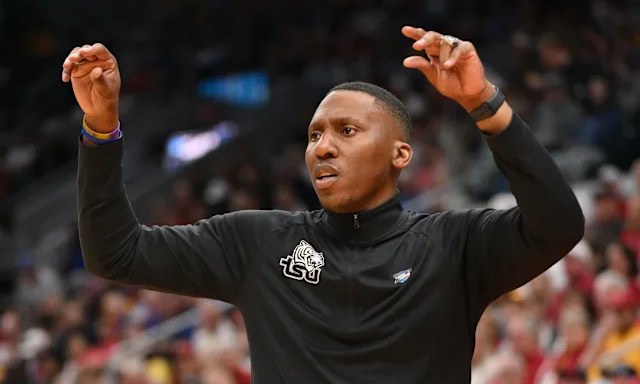
“My staff and I are incredibly blessed to continue leading this program,” said Coach Smith. “Last season, we laid the foundation and established a clear standard for a winning culture. We’re excited, motivated, and ready to keep building something that makes the Tennessee State University community proud.”
The 2010 NCAA champion was hired after stints as an assistant coach with his alma mater, Duke, Louisville, and, most recently, Memphis.
He took over in place of the previous coach, Brian Collins, who was hired as an assistant coach with the Memphis Grizzlies.
In his first year as head coach at Tennessee State, Smith helped lead the Tigers to a 23-10 overall record and a 15-5 mark against the Ohio Valley Conference.
This marked the first 20-win season for TSU since the 2015-2016 season, claiming a share of the OVC regular season title. Coach Smith was named co-OVC Coach of the Year.
Senior forward Aaron Nkrumah played a starring role for Tennessee State, being named OVC Player of the Year after leading the conference in scoring (17.7) and steals (2.8).
In a win that set a record for the largest margin of victory in an OVC championship game, TSU clinched its first NCAA tournament berth in 32 years.
“Nolan Smith has made an immediate and transformative impact on our program, leading with purpose, energy, and a commitment to excellence,” said Tennessee State Athletic Director Dr. Mikki Allen. “He is a winner whose passion for this university has energized our community and strengthened TSU basketball’s national profile. This well-deserved extension provides stability and momentum for the future, and we look forward to continued success under his leadership.”
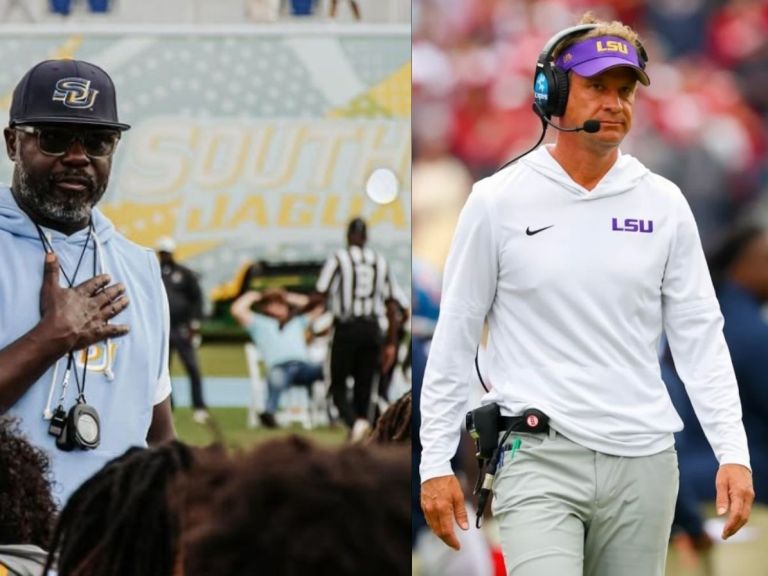
LSU head football coach Lane Kiffin and Southern head football coach Marshall Faulk will team up this week to host a coaches clinic.
The clinic at LSU is set for Friday and Saturday and will feature presentations, a crawfish social, and an opportunity for coaches to network.
Kiffin, in a press conference on Tuesday, said he is looking forward to working alongside Faulk and connecting with the “passionate” coaches around the state.
“You know, being out and around, there’s great football in Louisiana, obviously,” Kiffin said on Tuesday. “Great players, but I’ve said before, I love the way that the people in Louisiana are, but then when you get to football, the way that the coaches are and how much passion that they have and the players.”
Kiffin and Faulk to work together for first time
Kiffin said he wanted LSU to put on a strong event for the state’s coaches. “So, I’ve really challenged our guys to have a phenomenal clinic,” he said. “Spend time extra with all the coaches and breakout sessions of position groups so that we can help make the state better.”
Faulk is listed as a guest speaker for the event.
He also spoke warmly about Faulk and the chance to work alongside him. “I really didn’t know Marshall,” Kiffin said. “I actually, I don’t know what that would be like.”
Kiffin recalled Faulk’s playing days, including the famous 1999 St. Louis Rams Super Bowl team. “I was at the game when they beat the Bucs to go to the Super Bowl,” he said, adding that his father, Monte Kiffin, was the Tampa Bay defensive coordinator at the time. “I knew him as a player, obviously, and then I met him when we were speaking somewhere the other week.”
He said he is looking forward to Faulk’s role in the clinic and helping Southern’s staff. “So, um, excited for him to have this opportunity, and some of his staff here were here today and just trying to help them any way we can.”
According to the announcement, the clinic begins at 10:30 a.m. each day.
This article is one in a series of features produced in partnership with the Southwestern Athletic Conference, exploring the history of the SWAC from its founding in 1920 to the present day. The series will run during the months of April and May.
When the Prairie View A&M men’s basketball team won its NCAA Division I tournament game last month, it had joined an exclusive club of SWAC programs that had won an NCAA Division I tournament game. But the first SWAC team to break that barrier didn’t walk through an open door; they had to kick it down.
An Alcorn State team built for greatness
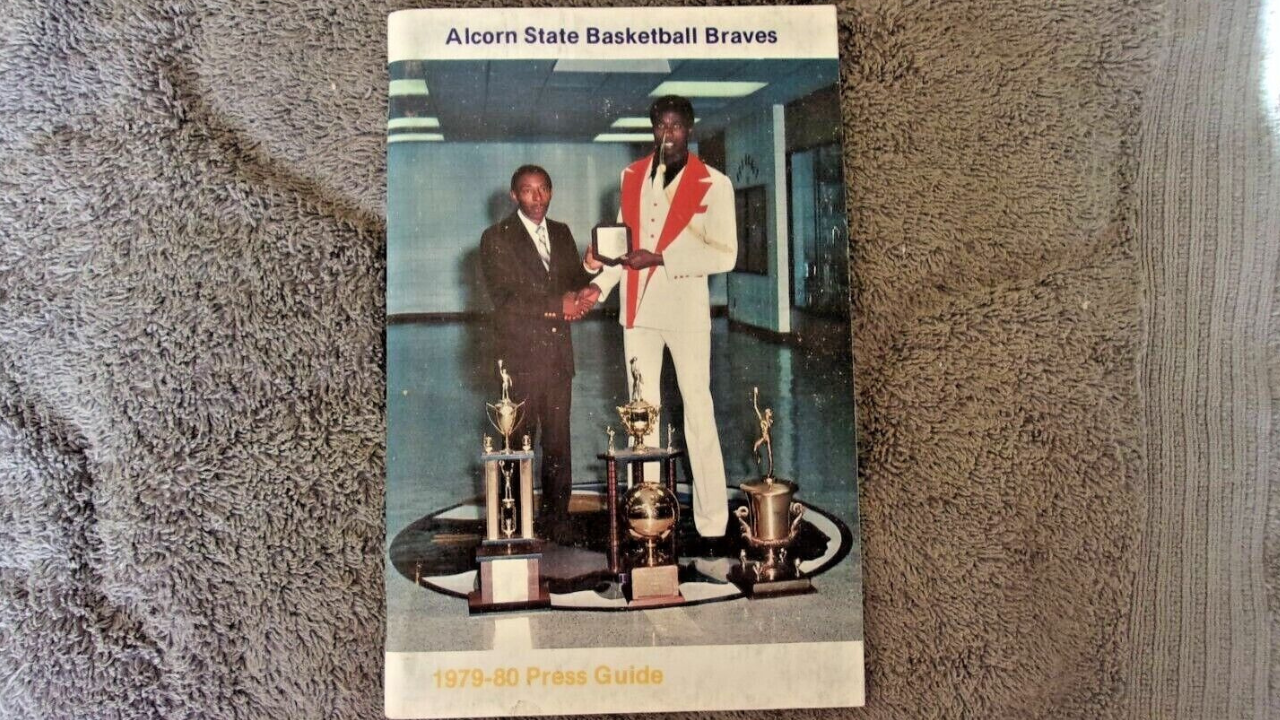
Nothing was going to stop the Alcorn State Braves from their appointed destiny in the 1979-80 season.
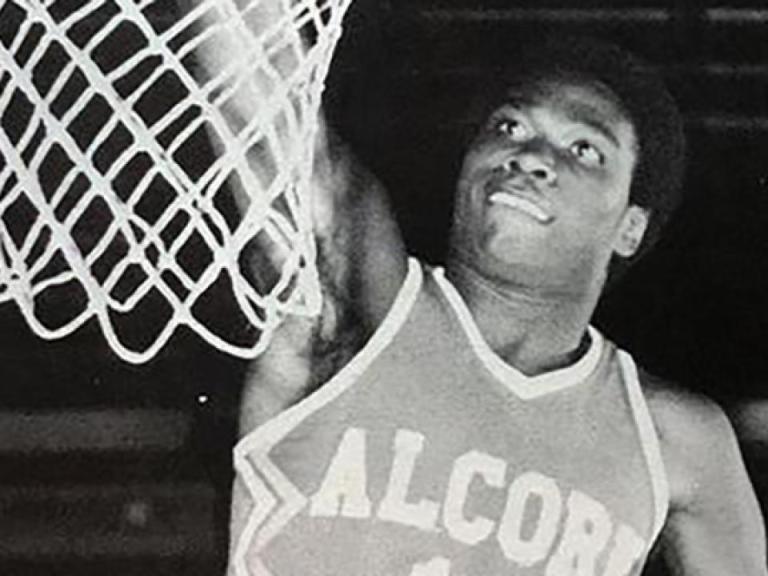
Alcorn had a coach who preached an up-tempo style in Davey “The Wiz” Whitney, a strong power forward who went on to play more than a decade in the NBA in Larry “Mr. Mean” Smith, and most important of all, a chip on their collective shoulders.
Image credit: archive.org
As good as that 1980 Alcorn State team was, the 1978-79 edition might have been better. The Braves went 25-0 in the regular season, then held off Mississippi Valley State 88-84 in the SWAC semifinals before dominating Southern 108-89 in the conference championship game.
One would think that an NCAA tournament appearance was on the horizon. Unfortunately, it was not.
The SWAC was in the middle of a probationary period after moving from Division II to Division I prior to the 1977-78 athletic and academic year. 27-0 Alcorn State was excluded from the NCAA tournament.
Taking It out on the NIT
The Braves took that disappointment out on Mississippi State in the opening round of the NIT. The Bulldogs featured future NBA players Rickey Brown and Wiley Peck, but the Braves were victorious 80-78.
Alcorn State then went on the road to Bloomington, Indiana, to face Bob Knight and the Indiana Hoosiers.
After playing a team with two future NBA players, the Braves now faced a team with four such players – Butch Carter, Mike Woodson, Ray Tolbert and Randy Wittman.
The Braves stayed close, only to fall short to the eventual NIT champs 73-69.
As the 70s faded out and the 80s began, Alcorn State was ready to make that leap.
The Braves started the 1979-80 campaign with a win against Southern Mississippi and an 83-80 loss to Mississippi State. That would be their last defeat of the regular season.
Led by the senior trio of Smith (who spent 13 years in the NBA with the Golden State Warriors, Houston Rockets and San Antonio Spurs), Clinton Wyatt and E.J. Bell, Alcorn State went unbeaten in SWAC play at 8-0.
They also had little trouble with MEAC opponents, defeating eventual conference champion Howard 95-48 at Burr Gymnasium on December 10.
Winning the SWAC Title
The 1980 SWAC men’s basketball tournament was held at the F.G. Clark Center on the campus of Southern University, where a month earlier, the Jaguars had given Alcorn their toughest test of the season before the Braves earned an 88-85 victory.
The rematch was not nearly as close this time around as the Braves won 116-92, setting a championship game showdown with Grambling.
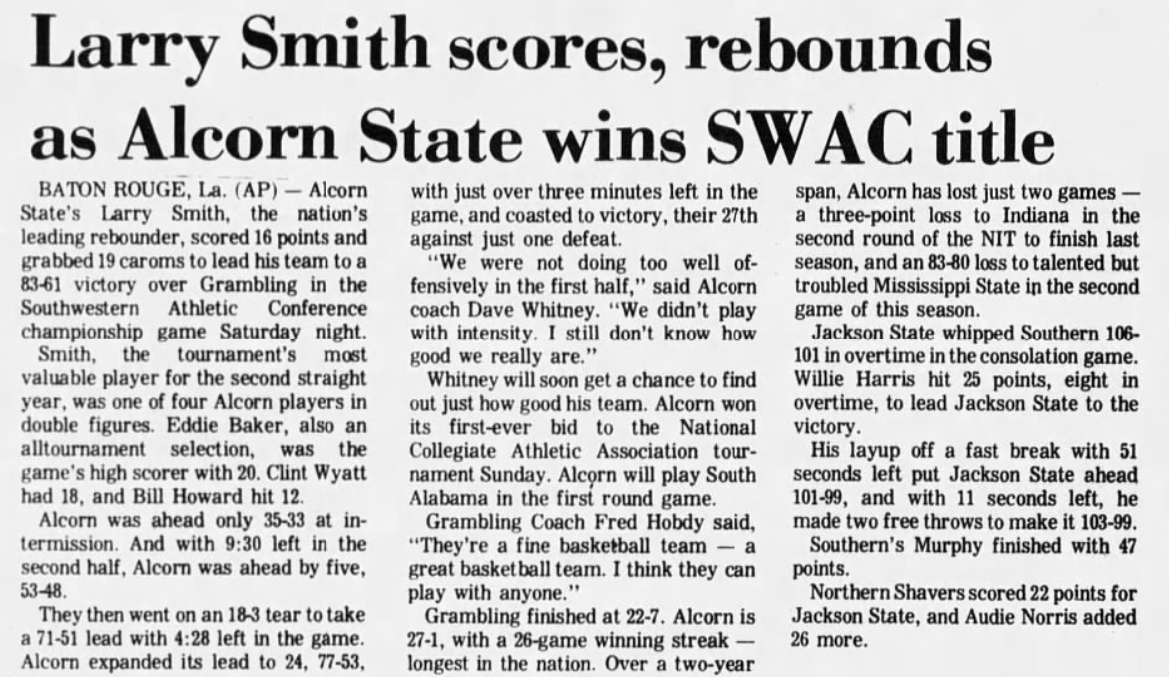
The Tigers, led by legendary coach Frederick Hobdy, made it tough on the Braves, staying with single digits deep into the second half. Smith spurred an 18-3 second-half run for Alcorn, helping them come away with the SWAC title by an 83-61 count.
Following the success of the 1979 tournament, which ended with Magic Johnson and Larry Bird facing off in the championship game, the NCAA expanded the tournament from 40 teams to 48. The SWAC’s probationary period was now over, so the Braves were granted a bid to the newly expanded tournament.
The top four seeds in each region earned a first-round bye, while the other eight faced off in the first round.
Outsmarting South Alabama
The Braves, seeded eighth in the Midwest region, faced off against No. 9 South Alabama at the Super Pit on the campus of the University of North Texas.
The nervousness on both sides was apparent, even as Alcorn and SAU already played each other that season, an 82-77 Braves win on Dec. 28th.
In the pre-shot clock era, the Sun Belt champion Jaguars decided the best way to slow down Alcorn’s 91 points per game offense was to keep the ball out of their hands.
South Alabama went into a stall, but instead of panicking, Davey Whitney had a plan.
“We needed to change the tempo,” Whitney told the Clarion-Ledger’s Roscoe Nance of going from a man defense to a 2-3 zone. “We wanted to cause some mistakes. They had no outside shooting. We just packed everything in.”
The gamble paid off as Alcorn ended the first half on a 12-2 run to take a 27-18 lead into the break.
South Alabama’s shooting woes continued in the second half, shooting just 38.9 percent for the game.
That was all the room the Braves needed to open up a 41-26 lead less than five minutes into the second half. Future NBA player Ed Rains tried valiantly to pull South Alabama back into the game, but Alcorn State had always had an answer.
And as the buzzer sounded, they had the final say; a 70-62 win for the first NCAA tournament win at the D-I level for themselves and the SWAC.
“This is the best team we’ve played all year, and that includes (eventual NCAA champion) Louisville,” South Alabama coach Cliff Ellis said afterward.
A bridge too far: Facing No. 1 LSU
The Braves’ next challenge was No. 1 seed LSU, led by forwards Rudy Macklin and DeWayne Scales. Alcorn State caught a break with Scales in foul trouble and trailed by just two points (51-49) at the half.
The first five minutes of the second half would be the first time in months that Alcorn State didn’t look like itself. Turnovers and missed shots piled up, and the Tigers pounced on the ASU errors, opening up a 57-47 lead and winning by a 98-88 count.
“We took advantage of their mistakes,” said Macklin, who scored a game-high 31 points. “They came out wild and didn’t play under control, which surprised me after the way they played in the first half.”
LSU coach Dale Brown complimented the Braves, saying, “We needed a great game to beat a great team. I think they [Alcorn] destroyed the myth that a Black team can’t play.”
A legacy that endures
The Braves went on to win three more SWAC championships under Whitney in the 80s, and when he returned for several more years in the late 90s and early 2000s, he took Alcorn State back to the NCAA tournament in 1999 and 2002.
The Physical Education Complex was renamed the Davey Whitney Complex in 1993, fitting for a man who not only turned a football school into a basketball power, but also showed future SWAC champions the way to compete with the Big Boys in the NCAA tournament.
Longtime North Carolina A&T athletics Director Earl Hilton will step down this summer at the conclusion of his contract, ending a 15-year tenure marked by historic athletic and academic growth, the school announced Tuesday.
University leaders said a national search for Hilton’s successor will begin immediately. He will remain in the role until a new director is selected and in place.
Hilton has led A&T’s 17 intercollegiate sports programs since 2011.
“North Carolina A&T is tremendously grateful for the outstanding leadership Earl has provided for our student-athletes over the past 15 years,” Chancellor James R. Martin II said in a statement about Hilton. “He created an environment in which more than 300 student-athletes each year never lose sight of the fact that they are students first. We have especially appreciated his steady hand in a time of unprecedented change throughout the NCAA.”
Hilton made immediate impact on and off the field
The school reported that under Hilton, student-athlete graduation rate increased by more than 51%, annual giving to athletics rose, and Aggies sports teams captured more than 70 individual, team, and national championships, including multiple HBCU national football titles.
From 2015 to 2019, A&T football became the standard-bearer for HBCU athletics with four Celebration Bowl victories. Track and field athletes added to the school’s national profile with three medals — two gold — at the 2021 Tokyo Olympics and a runner-up finish at the 2022 NCAA Indoor Championships, the highest ever for a Division I HBCU.
Photo: North Carolina A&T athletics
Hilton also oversaw the launch of two new varsity programs in men’s and women’s golf and guided the Aggies’ transitions from the Mid-Eastern Athletic Conference to the Big South Conference in 2020 and the Coastal Athletic Association in 2022, though the football team has struggled since moving to the Coastal.
In recognition of his work, Hilton was named Athletics Director of the Year for NCAA Football Championship Subdivision institutions in 2019.
Hilton proud of work at A&T
Reflecting on his tenure, Hilton said he was proud of how far the program has come.
“It has been my singular privilege to have worked with so many wonderful and talented student-athletes and the dedicated coaches and staff who support them,” Hilton said in a statement. “I have been blessed to be part of a remarkable community of boosters and fans who have sustained us with unflinching resolve. I am honored to have witnessed historic academic and athletic achievement and look forward to our continued success under the leadership of Chancellor Martin and the next athletics administration.”
Jones, an LSU alum, previously led the Tigers from 2012-17, then rebuilt Texas Southern into a steady SWAC contender.
Dr. Kenyatta Cavil of Inside the HBCU Sports Lab first reported in late March that Jones would be leaving his post at Texas Southern for LSU
Jones, who has led the Tigers since 2018, helped keep Texas Southern among the Southwestern Athletic Conference’s top programs and guided the team through multiple successful seasons. His departure would mark the end of a notable run in Houston.
The move also brings Jones back to Baton Rouge, where he previously served as LSU’s head coach from 2012 to 2017. During those five years, Jones compiled a 90-72 overall record and a 42-48 mark in Southeastern Conference play.
He will be an assistant under the new coach Will Wade. Wade returns to LSU after coaching one season at North Carolina State.
Photo: LSU Athletics
Jones led LSU to one NCAA Tournament appearance and one NIT berth, and the 90 wins remain the most by any LSU coach in his first five seasons.
In 2024, Jones had signed a 3-year contract extension that would have kept him at TSU through the 2029 season
What loss of Johnny Jones means for Texas Southern
For Texas Southern, the development would mark the possible end of a run in which Jones restored the program’s credibility in the SWAC and kept the Tigers in the postseason conversation.
Jones’ departure would be felt well beyond Houston, where he became one of the most recognizable names in HBCU basketball. Texas Southern has been among the SWAC’s most stable programs under his leadership, and losing a coach with Jones’ profile would be a significant shift for the conference.
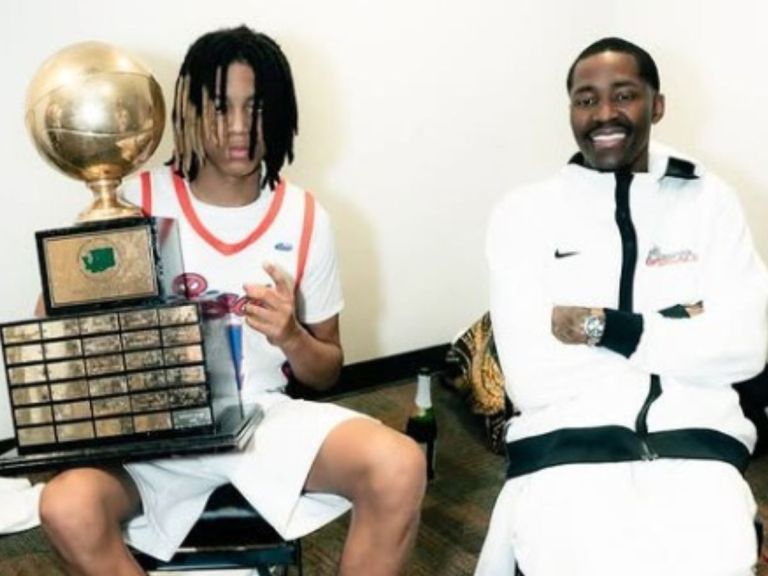
North Carolina Central added a notable name to its recruiting board after offering Seattle standout JJ Crawford, the son of former NBA guard Jamal Crawford, according to his post on X.
Crawford thanked head coach LeVelle Moton and the Eagles’ staff for the opportunity, underscoring the program’s continued effort to get involved early with high-upside talent.
The offer carries extra weight because Crawford already arrives with national recognition and a familiar basketball lineage. As the son of a former NBA player, he brings both pedigree and promise to a recruitment that could grow quickly as more programs take notice.
For NC Central, the move fits a long-term recruiting approach that has helped the program stay active in conversations with emerging prospects. Getting in early with a player of Crawford’s profile also signals the Eagles’ willingness to compete for talent well beyond their usual footprint.
Crawford has played under his father in the Nike EYBL grassroots circuit for the Northwest Rotary Rebels.
“It means a lot to me to play against the best players in the world, to see how good everybody else in the country is and to work on my game and see where I’m at,” Crawford told the USA basketball website.
The Eagles’ offer adds another layer to what could become a closely watched recruiting story in the years ahead.
In addition to NC Central, Crawford, a freshman (class of 2029) at Rainier Beach (Seattle), has 12 Division I offers, including ones from Kansas, Missouri, USC, Oregon and his father’s alma mater, national champion Michigan.
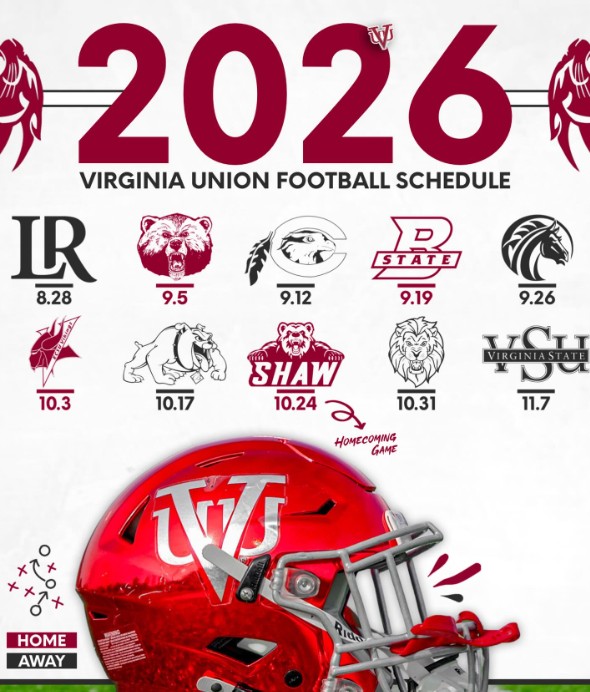
Their journey begins on the road in a matchup against perennial Division II contender Lenoir-Rhyne on Friday, August 28. The last time these teams played each other was in November 2024 when the Panthers claimed a dominant 44-12 win to advance to the Regional Finals of the Division II Playoffs.
They will then open their conference schedule the following Saturday against the Livingstone Blue Bears in what will also be their home opener.
Virginia Union to face old CIAA foe
On Saturday, September 12, the Panthers will take a trip down memory lane when they go on the road to face former CIAA foe Chowan. This will be their first time facing Chowan since they left the conference in 2022, a game that Virginia Union lost, virtually eliminating them from CIAA championship contention.
Photo: VUUFB/Instagram
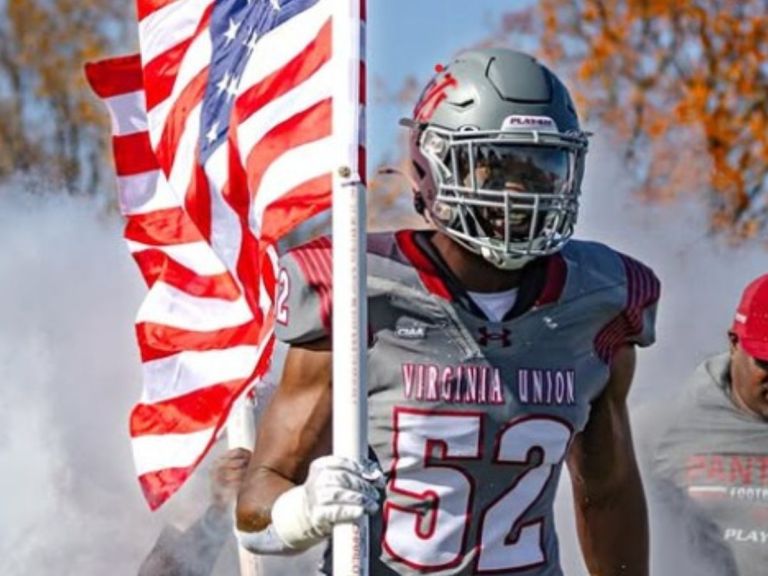
The rest of the season will see Virginia Union deep in conference competition, with notable games including a clash on the road against Fayetteville State on September 26, a homecoming date against Shaw on October 24, and ending the season like it does every year against Virginia State on November 7.
The Virginia Union Panthers finished the 2025 season with a 9-3 overall record, having fallen short of a third straight CIAA championship after losing 45-21 against Johnson C. Smith in the title game.
Despite this, VUU made it into the Division II playoffs for the fourth straight year, becoming one of five teams to do so in that time span.
The award is named for Winston-Salem State icon Clarence “Big House” Gaines, the long-time men’s basketball coach at Winston-Salem State from 1946 to 1993.
Gaines won eight CIAA championships, six CIAA coach of the year awards, and with Hall of Famer Earl “The Pearl” Monroe leading the way, won the NCAA Division II championship in 1967.
After five years as head coach at Virginia Union, Terry was hired last April to coach the Winston-Salem State women.
The Lady Rams won the CIAA regular season title with a 28-4 record.
That record included a dominant run in the conference tournament in Baltimore, where the Lady Rams outscored their opponents (Bluefield State, Claflin and previous champion Fayetteville State) 198 to 124.
WSSU took down Glenville State 88-71 and Gannon 67-48 before losing a heartbreaking 65-64 decision to host Indiana University of Pennsylvania in the Atlantic Region Finals.