
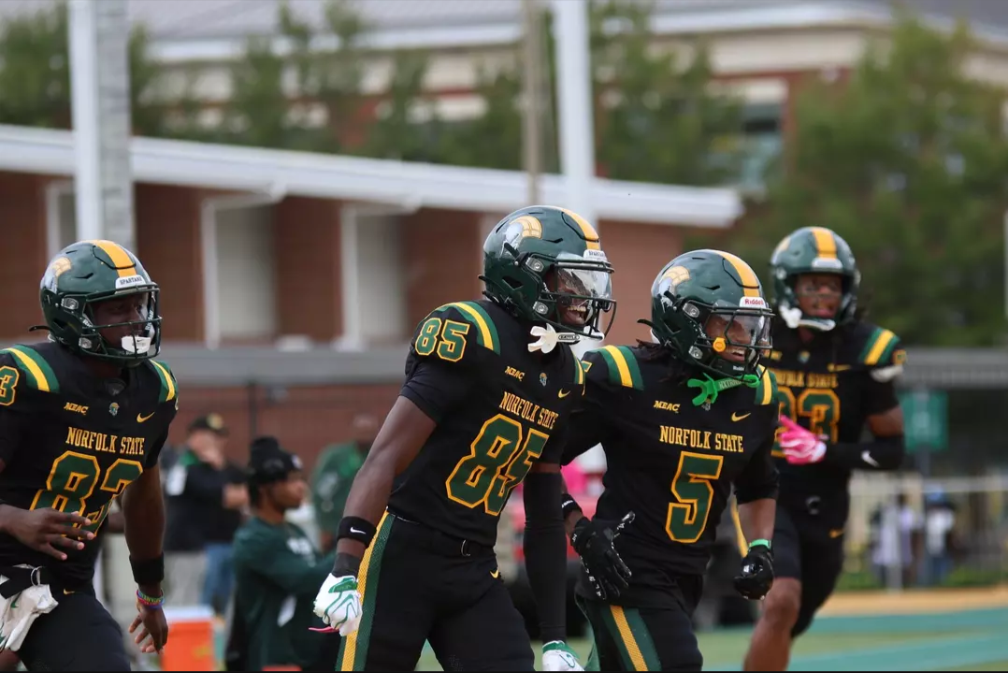
Norfolk State enters Mid-Eastern Athletic Conference play as a totally different team than a year ago.
The Spartans are 4-3, a significant improvement from the 1-6 start that preceded a 1-11 finish in Michael Vick’s first season. They are scoring more, running the ball more effectively, and allowing fewer yards per game.
Still, the improvement extends beyond the scoreboard. Quarterback DaJean Golmond has provided passing efficiency and mobility, running back Jalyn Daniels has emerged as an explosive weapon, and defensive lineman Brenden Thompson has helped lead a unit that is making life more difficult for opposing offenses.
The Spartans have more to prove against MEAC competition. But the early evidence suggests a team better equipped to compete than the one that struggled through 2025.
By the numbers
Scoring: The Spartans have increased their scoring average from 20 points per game through the first seven games of 2025 to 35.3 this season.
Points allowed: Norfolk State surrendered 34.1 points per game through its first seven contests in 2025. That figure has fallen to 23.4 this season.
Total offense: The Spartans are averaging 415.6 yards per game in 2026.
Rushing offense: Norfolk State is averaging 214 rushing yards per game, producing 5.5 yards per attempt.
Total defense: Opponents are averaging 292.6 yards per game, including just 101 rushing yards.
The offensive production represents a meaningful change. Norfolk State has scored 247 points in seven games, compared with 140 through the first seven games of 2025. The defense has allowed 164 points, down from 239 over that same stretch last year.
Those comparisons show a team that has become more competitive. They do not, by themselves, prove that Norfolk State has improved by the full statistical margin against equivalent opposition.
The schedule is a critical part of the story
Norfolk State’s 2025 opening stretch included Towson, Virginia State, Rutgers, Sacred Heart, Wagner, Hampton and Wofford. The Spartans lost six of those seven games, with three defeats decided by seven points or fewer.
The 2026 schedule has offered a different combination. Norfolk State opened with a 56-0 win over Winston-Salem State, then lost to Old Dominion 31-10 and Virginia 59-3. The Spartans subsequently defeated Hampton 42-21, Chicago State 38-14 and Virginia-Lynchburg 62-0, while losing to Robert Morris 35-34.
The FBS games exposed the gap between Norfolk State and higher-level competition. The shutout victories, meanwhile, boosted the team’s offensive averages against weaker opponents.
That context matters. A 62-point performance against Virginia-Lynchburg does not carry the same predictive value as a comparable performance against a strong FCS opponent. Norfolk State’s loss to Robert Morris also shows growth against a relatively quality opponent.
But the Spartans have demonstrated an ability to win games they struggled to finish last season. Their 42-21 victory over Hampton is particularly useful because Hampton also appeared on Norfolk State’s 2025 schedule, when the Spartans lost 41-34.
The year-over-year improvement is not just about scoring against weaker opponents. Norfolk State has established a productive running game and reduced its overall defensive workload. Those are encouraging signs, even if the schedule prevents a definitive conclusion about how much better the team is against comparable competition.
The players behind the improvement
DaJean Golmond has brought efficiency to the passing game
The quarterback has completed 61 of 96 passes for 774 yards, six touchdowns and one interception through seven games. His 63.5% completion rate and 149.81 passer rating reflect an efficient start.
Golmond has also rushed for 157 yards and two touchdowns on 20 carries, averaging 7.9 yards per attempt. That mobility adds another dimension to an offense that is averaging 214 rushing yards per game.
Golmond is not the team’s only passing option. Deljay Bailey has thrown for 606 yards and four touchdowns. That depth gives Vick options as he looks to sustain the offense through conference play.
Jalyn Daniels is the engine of the ground game
Daniels has rushed for 610 yards and four touchdowns on 99 carries, averaging 6.2 yards per attempt.
The team’s overall rushing numbers are particularly important entering MEAC play. Norfolk State is averaging 214 rushing yards per game, compared with 143.8 yards per game over the full 2025 season.
A productive ground game can shorten games, create manageable passing situations and help keep the defense off the field. For a team that allowed 35.6 points per game in 2025, that balance could become especially valuable as conference opponents grow more familiar with the offense.
Brenden Thompson is setting the defensive tone
Thompson leads Norfolk State with 47 total tackles through seven games. The defensive lineman also has five tackles for loss, two sacks and four quarterback hurries.
His production is part of a broader defensive improvement. Opponents average 292.6 total yards per game and 101 rushing yards, while Norfolk State has 17 sacks as a team.
The schedule is again a factor, but the current numbers suggest Norfolk State is doing a better job of disrupting offenses and preventing opponents from establishing a consistent ground attack.

Vick says the difference starts with focus
The statistical changes offer one view of Norfolk State’s progress. Vick says the change in daily expectations has been just as important.
Asked about the biggest jump from last season to this one, the second-year coach pointed to the culture within the program.
“I think it’s just our focus, like down from myself down to the coaches, and from us to the players,” Vick said this week. “Focus was different. The competitive edge was different.”
Vick described a practice environment built around consistent accountability. When he sensed that players were becoming complacent, he said, he made practices more demanding.
He also made clear that players had a choice about whether to embrace those expectations.
“If you step on the field, you’re gonna give me 110 percent. Not just me, but give yourself 110 percent because it’s gonna show,” he said.
He also acknowledged that he is still learning as a head coach.
“I’m still learning, man. I’m still growing as a coach,” Vick said, describing the transition as something that improves “each and every day, whether it’s win, lose, or draw.”