
This article is one in a series of features produced in partnership with the Southwestern Athletic Conference, exploring the history of the SWAC from its founding in 1920 to the present day. The series will run in April and May.
Before its days in the NCAA Division I ranks, the Southwestern Athletic Conference (SWAC) was home to some of the most prominent basketball players who stamped themselves among the greats in the history of the sport.
Names such as Naismith Basketball Hall of Famers Willis Reed and Zelmo Beaty, as well as ABA All-Time Team member Jimmy Jones and former NBA All-Star Bob Love, defined the SWAC’s early identity, setting a standard for those who followed.
As the conference transitioned into the NCAA, it would continue to produce NBA-caliber talent, including former NBA champion and eventual coach Avery Johnson and two-time NBA champion Lindsey Hunter.
With all the great talent that goes on to have exceptional professional careers, there are some hidden gems who produced historic achievements that many casual fans would never recognize.
One of those kinds of players is former Texas Southern forward Harry Kelly, who, from the moment he stepped on the court for the Tigers, showed himself to not only be one of the most prolific scorers the conference has ever seen, but that college basketball has seen in general.
A Scorer Like No Other
Nicknamed “Machine Gun,” Kelly wasted no time making a name for himself, putting up averages of 29.0 points (ranked third in the NCAA) and 7.9 rebounds as a freshman.
The Mississippi native would continue to add to his legacy, leading the NCAA in scoring in each of his final two seasons with a combined average of 29.3 points per game.
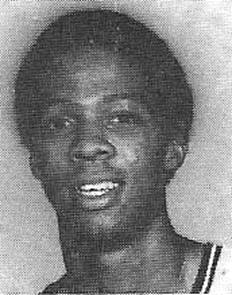
He is one of only three SWAC players to lead NCAA Division I scorers, doing so in each of his final two seasons. He’s also one of seven NCAA Division I players to lead the country in scoring in consecutive years.
His 60-point performance against Jarvis Christian in 1983 is the most points scored in a game by a SWAC player in the conference’s time in the NCAA Division I ranks.
Texas Southern head coach Bob Moreland raved about Kelly’s ability to score the basketball, saying, “I don’t know what his range was, but it was beyond what they’re shooting today. If they had the three-point shot when he played, he would have scored more than 4,000 points.”
More Than Just Points
Kelly was also an excellent rebounder for the Tigers, averaging 9.9 for his career, including an average of 11.6 in his final two years.
As prolific a scorer as he was at Texas Southern, rebounding was a part of Kelly’s game that he took great pride in and turned out to be a byproduct of team success.
“I knew when I shot, if I missed I had to get the rebound and put it back up before they beat me up,” Kelly said in a 2010 interview with USA Today. “I had a jumper, but I took pride in rebounding. I had some nights where the jumper was falling, and I was lighting it up. When it wasn’t, I tried to shoot free throws and get rebounds. When it was falling, it was on. I had the freedom to shoot. Coach Moreland gave me freedom as long as I took good shots. He knew I pretty much would take good shots.”
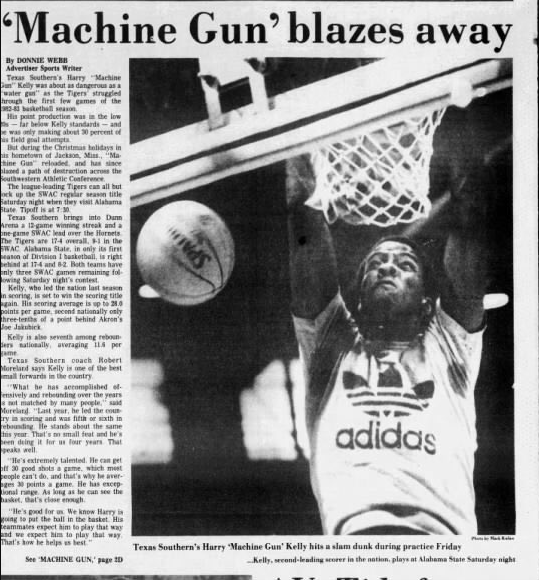
This attitude paid dividends for Texas Southern, recording 20-win seasons in 1982 and 1983, clinching a berth in the SWAC championship game in the latter year.
At the end of his college career, Kelly finished with 3,066 career points, making him the then-third-leading scorer in NCAA history (he now sits in 10th) and the SWAC all-time leading scorer (he was eventually passed by Mississippi Valley State’s Alphonso Ford).
Adding in his 1,085 career rebounds made him the first player in NCAA history to finish his career with at least 3,000 career points and 1,000 career rebounds (three other players have since joined him).
Kelly ruled as the SWAC Player of the Year in each of his four seasons in the conference, the only player in SWAC history to do so. He is also one of only two players to be named to the All-SWAC First Team in all four seasons.
From Draft Day to Hall of Fame
With a career in the pros potentially on the horizon, the Texas Southern star began taking part in offseason scrimmages to test his skills against other NBA-caliber talent.
In games that featured future NBA greats Hakeem Olajuwon and Clyde Drexler of the University of Houston’s Phi Slamma Jamma, as well as former Jackson State star and then Golden State Warriors forward Purvis Short, Kelly held his own, creating a buzz entering the 1983 NBA Draft.
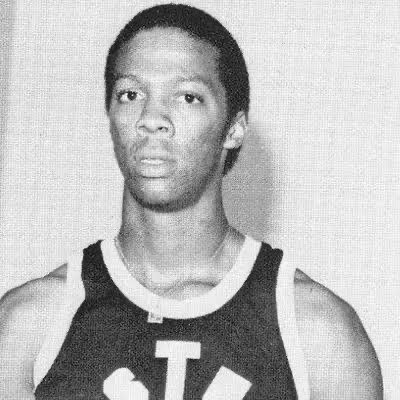
However, after being selected in the fourth round by the Atlanta Hawks, Kelly was cut during rookie camps and never found his way back into the league.
A strong performance in a California Summer League with other NBA free agents, during which he averaged 30 points per game, was not enough to yield any other significant professional offers.
Despite this, Kelly’s impact on the conference remains intact, having his jersey retired by Texas Southern shortly after his senior season ended, and was eventually immortalized in the SWAC Hall of Fame’s 2006 class.