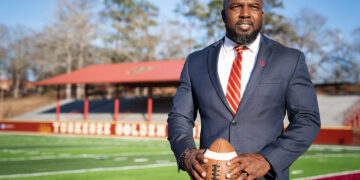

Former Jackson State football player Antwan Owens still remembers how little anyone understood about name, image and likeness opportunities when he made history five years ago.
Owens, widely recognized as the first college athlete to sign an NIL deal when the practice became authorized by the NC.
“At the time, the space was brand new,” Owens told HBCU Sports. “We didn’t really understand the magnitude of what we were doing.”
Owens’ first deal came with 3 Kings Grooming, a Black-owned company led by three brothers, two of whom had ties to the Atlanta area, where Owens previously built connections during his time around Georgia Tech. When he transferred to Jackson State to play under Deion Sanders, the alignment made sense.
“It was just a natural fit,” Owens said of the NIL. “They already had a plan in place, and we kind of took advantage of the opportunity.”
That plan quickly turned into a national rollout, highlighted by a billboard in Times Square in the heart of New York City featuring Owens—an experience he described as surreal.
“A small-town kid from Tallahassee, Florida, standing in Times Square with people asking for autographs and pointing to a billboard with my face on it—that was something I never imagined,” he said.
How NIL changed Antwan Owens
After signing that historic NIL deal, Owens indicated that the move would be “life-changing, generationally life-changing.”
In the years since, Owens said the true value of his NIL experience extended far beyond the initial deal. It provided a foundation in business, financial literacy and networking that continues to shape his career.
“I learned how to structure an LLC, how to handle taxes, how to build something that’s profitable,” he said. “That exposure changed everything for me.”
View this post on Instagram
Owens has worked on several political campaigns, including efforts supporting Stacey Abrams’ national initiatives and local races in Tallahassee. He also assisted a city commissioner representing his home area and continues to work with the official as he campaigns for mayor.
“These connections last a lifetime,” Owens said.
In addition to his political involvement, Owens has focused heavily on community outreach. He founded a 501(c)(3) nonprofit organization during his time at Jackson State, launching initiatives that included delivering 20,000 bottles of water to campus during the Jackson water crisis.
The organization has continued its efforts in the years since, hosting multiple community drives, including an annual turkey giveaway.
Owens said those experiences reflect the broader impact NIL can have when athletes use their platform beyond the field.

Now 27, Owens serves as the NIL director at the University of Central Florida, overseeing all 16 sports programs. His role includes educating athletes on financial management, facilitating brand partnerships and emphasizing community engagement.
Owens has also been recognized in Forbes Magazine as a 30 under 30 honoree for his work connecting athletes with out-of-the-box branding deals and investment opportunities.
“That’s the job—helping athletes understand the process and how it impacts their future,” he said.
Five years later, college quarterbacks are earning millions.
NIL has grown into something far different from what college sports leaders envisioned when the NCAA responded to pressure from lawsuits, state laws and Congress. Even President Donald Trump has sought action on the matter to “save” college athletics.
According to NIL servicer Opendorse, total NIL-related spending will reach well within the billions in 2026, including direct payments from schools, endorsement deals, sponsored content and licensed merchandise.
NIL should benefit everyone, says Owens
Despite NIL’s rapid growth and its emergence as a major recruiting tool, Owens believes the current landscape has drifted from its original purpose.
“This isn’t really NIL anymore,” he said. “It’s turned more into a revenue-sharing model. NIL was supposed to be about marketing and exposure, not just upfront payments.”
He warned that the current system may be unsustainable without a clearer structure and regulation, advocating for a model that balances athlete compensation with community impact.
“These universities are part of communities,” Owens said. “It should benefit not just the athlete, but the school, the city, and the people around it.”
Owens also stresses the importance of preparing athletes for life beyond sports, noting that most will not have long professional careers.
“You’ve got to maximize your moment,” he said. “Not just for now, but for your kids and your grandkids. That’s how you build generational wealth.”
As one of the first to navigate NIL and now a leader shaping its future, Owens views his role as both responsibility and opportunity.
“I want to be one of the most influential people in this space,” he said. “Because I’ve lived it. I understand what these athletes are going through, and I know what’s best for them—not just as players, but as people.”