

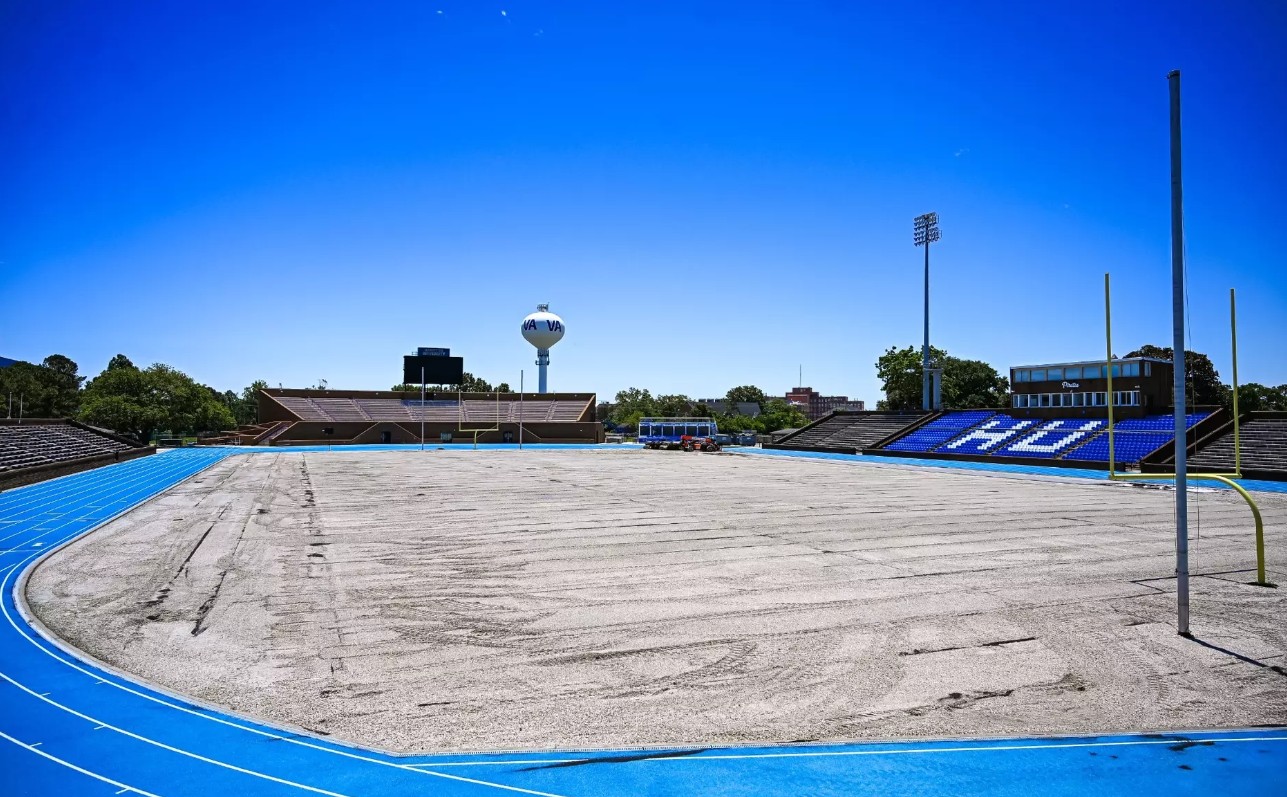
Hampton University’s Armstrong Stadium, one of the oldest venues in HBCU athletics, is getting a major renovation.
The school announced that the multipurpose facility will undergo a $3.2 million facelift this summer.
“We are committed to providing a premier environment for all of our student-athletes to train, compete, and succeed,” Anthony D. Henderson, the school’s athletics director, said in a statement. “This project represents a significant investment in the future of Hampton Athletics, enhancing performance, safety and the overall student-athlete experience.”
What are the upgrades?
The project will replace the stadium’s aging playing surface and track while enhancing functionality for multiple athletic programs. Henderson said the upgrades reflect a broader commitment to student-athlete development and program growth.
The current AstroTurf 3D Decade surface, installed in 2014, has reached the end of its projected lifespan. It will be replaced by Shaw Sports Turf’s Legion 2.0 hybrid synthetic system, designed for durability, safety, and consistent play. The new surface will support football, women’s soccer, and lacrosse, expanding the stadium’s multi-sport capabilities.
Hampton football coach Van Malone called the upgrade a major step forward for the program.
“This upgrade is a game-changer for our program,” Malone said. “Having a high-performance surface enhances player safety, supports the speed and physicality of our game, and creates a championship-level environment for our student-athletes.”
The renovation will also allow Hampton’s women’s soccer team to host matches on campus for the first time in recent years after previously playing in off-campus locations. Head coach Sam Cain emphasized the impact on both competition and campus engagement.

“Being able to play on campus in a first-class facility strengthens our identity and gives us a true home-field advantage,” Cain said.
In addition to the field, the surrounding eight-lane track will be replaced with the Beynon BSS 1000 system, engineered for shock absorption and energy return. Field event areas will also be relocated adjacent to the stadium to improve functionality and meet competition standards.
Director of Cross Country and Track and Field Maurice Pierce said the upgrades will elevate the program’s recruiting and hosting capabilities.
“It allows our teams the opportunity to compete at home and positions us to host youth, high school and collegiate championship meets,” Pierce said.
Construction is being led by NPSG Built, LLC, in partnership with Advanced Sports Group, which has completed projects for organizations including the NFL’s Las Vegas Raiders and Georgia Tech. Civil ForSite, PLLC is serving as the project’s engineering firm.
Originally opened in 1922, Armstrong Stadium has long been a cornerstone of Hampton athletics. The facility was formally dedicated in 1928 and is named after Brig: Gen. Samuel Chapman Armstrong, the university’s founder and first president. Over the years, the stadium has undergone several upgrades, including the addition of a video board and premium seating, and currently holds a capacity of 9,710.