

Install the app
How to install the app on iOS
Follow along with the video below to see how to install our site as a web app on your home screen.
Note: This feature may not be available in some browsers.
You are using an out of date browser. It may not display this or other websites correctly.
You should upgrade or use an alternative browser.
You should upgrade or use an alternative browser.
The Worst Schools in the U.S. (HBCU schools)
- Thread starter patsnation80
- Start date





The Founder
Well-Known Member
****yawn****
What’s for lunch?
What’s for lunch?
The Founder
Well-Known Member
This could have been good smack material TBH but this is just sad...
Who is his sponsor?

THEESwacProphet
THEE SWACs Neighborhood Prophet
surprised SUcks ain’t on that list ... they got former band directors turned federal prisoners, professors having intercourse with students, and a board that is just as corrupt as our current president.... that glass house SUcks live in is a mother I’ll tell you what...
The Founder
Well-Known Member
The list has little to do with corruption, sex scandals, and imprisonments, but everything to do with how much individuals earn after graduating from certain schools. This is how schools are being measured now or which schools provide more bang for the buck.
I honestly have never placed any credence to these reports because they only have information from a limited source.

JAG89
THE NEW AMERICA'S TEAM
I honestly have never placed any credence to these reports because they only have information from a limited source.
I think a lot of this came about due to the student loan default rate at for-profit schools, especially those massive online programs. Individuals were graduating from those schools with massive student loan debt with no income to pay off those loans. This is why the Obama Administration placed limits on student loans for certain programs that produced little in earnings after graduation. The Trump Administration wants to reverse that so that for-profit schools can get rich by allowing students to create massive student loan debts with no means of paying off those loans. When I graduated from SU, I paid off my student loan in less than 5 years. As an Engineer from SU , I made just as much or more than an Engineer who graduated from Howard, but Howard is way more expensive than SU. IMO, SU should market this to attract more students into its engineering programs. Recently, another list was done on schools that were hidden gems. I believe SU was 4th on that list and it specifically mentioned SU's engineering program. It's not by coincident that the current Secretary of Illinois Department of Transportation is a SU engineering graduate. Ironically, the current Secretary of Louisiana Department of Transportation and Development is not an engineer, but he did receive his PhD in Public Policy from SU.
Last edited:
JAG89
THE NEW AMERICA'S TEAM

jsupop33
Loyalty & Respect
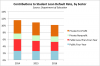
When I was at the Dept of Education, we started collecting salary information from the Social Security Administration @The Founder
JAG89
THE NEW AMERICA'S TEAM
It would be nice if the government could spend the same amount of energy in helping folks with insurance, especially individuals with medical conditions that limits them to function at full capacity. But we have politicians who get elected to office that is only concerned about helping private industries making a profit.
jsupop33
Loyalty & Respect
The original idea was to measure ROI of schools. It started with the for-profit industry and eventually it would have spread to all schools. Private HBCUs in particular sided with the for-profit industry because many of them would have been in trouble. I remember a meeting back in 2011-2012ish when Benedict College was being discussed. At the time Benedict graduation rate dropped below 30% and cost was about 25k a year.
Someone asked the question of why should the agency give a student over 100k in aid to attend a school that that they only had a 25% chance of graduating from. No one had a good answer.
Someone asked the question of why should the agency give a student over 100k in aid to attend a school that that they only had a 25% chance of graduating from. No one had a good answer.
Last edited:
The Founder
Well-Known Member
The original idea was to measure ROI of schools. It started with the for-profit industry and eventually it would have spread to all schools. Private HBCUs in particular sided with the for-profit industry because many of them would have been in trouble. I remember a meeting back in 2011-2012ish when Benedict College was being discussed. At the time Benedict graduation rate dropped below 30% and cost was about 25k a year.
Someone asked the question of why should the agency give a student over 100k in aid to attend a school that that they only had a 25% chance of graduating from. No one had a good answer.
I think the true original idea was to limit funding to smaller colleges, universities, and especially HBCUs with hopes that they would close.
jsupop33
Loyalty & Respect
Na, the for-profit industry was running wild from 2005-2010. They had to be reigned in. However, the entire gainful employment concept took a single phrase in the Higher Education Act and used it to write a comprehensive law tying the access to student aid to employment outcomes of graduates of for-profit schools.I think the true original idea was to limit funding to smaller colleges, universities, and especially HBCUs with hopes that they would close.
Courts ruled that the agency could only track Title IV recipients. The for-profits protested and said that all universities should be held to the same standard. The private HBCUs supported the for-profits because a lot of them had worse numbers than the big for-profit colleges when you compared college debt to earnings. They recognized that if the agency ever expanded the law, a lot of private HBCUs would eventually be kicked out of the Title IV program.
JAG89
THE NEW AMERICA'S TEAM
Na, the for-profit industry was running wild from 2005-2010. They had to be reigned in. However, the entire gainful employment concept took a single phrase in the Higher Education Act and used it to write a comprehensive law tying the access to student aid to employment outcomes of graduates of for-profit schools.
Courts ruled that the agency could only track Title IV recipients. The for-profits protested and said that all universities should be held to the same standard. The private HBCUs supported the for-profits because a lot of them had worse numbers than the big for-profit colleges when you compared college debt to earnings. They recognized that if the agency ever expanded the law, a lot of private HBCUs would eventually be kicked out of the Title IV program.
I totally agee, because too many individuals were graduating college with $200k-plus student loan debt with jobs barely making $30k per year. The initial intent was to reduce the student loan default rate. For-profit schools made the student loan default rate soar exponentially.
JAG89
THE NEW AMERICA'S TEAM
I think the true original idea was to limit funding to smaller colleges, universities, and especially HBCUs with hopes that they would close.
Due to its low tuition cost, I think Grambling is okay. Grambling needs to focus more on its programs that create high earnings after graduation, which is why I never understood why Grambling discontinued its Nursing Program. It would be nice if Grambling had an Engineering Program, but I'm sure Louisiana Tech is in total opposition to that. Small private HBCUs are the main ones in danger.
The Founder
Well-Known Member
Due to its low tuition cost, I think Grambling is okay. Grambling needs to focus more on its programs that create high earnings after graduation, which is why I never understood why Grambling discontinued its Nursing Program. It would be nice if Grambling had an Engineering Program, but I'm sure Louisiana Tech is in total opposition to that. Small private HBCUs are the main ones in danger.
You have to have open minded people employed to get to where you need to be. I'm not fond of the Provost or a few others in administration. What GSU doesn't understand is how to develop programs for the the industry. When you have professors who have never been practitioners they are teaching the same philosophy from 30 years ago from a book written 40 years ago.
For example I wanted to incorporate a 4 Master of Governmental Relations program that would attract damn near all ROTC students and students ho aspired to do some type of work with government. I wanted former high ranking military members to instruct the various tongue and quill and alot of other aspects. One expect that I hated in college was when instructors tell their students that a paper should a certain number of pages. No the question should be what type of audience and why. I remember being on a team that debriefed President Clinton and briefed President Bush on the Nuclear Weapons Deterrent. I was a fly on the wall but when I was assigned my task I thought I need a ton of information. Well Bill Clinton knew how to interpret numbers while Bush preferred graphs etc....neither was going to read 20 pages. They wanted ABC and done.

Earle
Well-Known Member
Due to its low tuition cost, I think Grambling is okay. Grambling needs to focus more on its programs that create high earnings after graduation, which is why I never understood why Grambling discontinued its Nursing Program. It would be nice if Grambling had an Engineering Program, but I'm sure Louisiana Tech is in total opposition to that. Small private HBCUs are the main ones in danger.
I live here in Monroe which is the GSU t.v. coverage area. As I understand it, they have received approval from the Louisiana Board of Regents to re-start their nursing program. This is a really good move for them because you can't go wrong with a Bachelor's/Master's in nursing. Like SU, they have also instituted a cyber security program.
Last edited:
Earle
Well-Known Member
I totally agee, because too many individuals were graduating college with $200k-plus student loan debt with jobs barely making $30k per year. The initial intent was to reduce the student loan default rate. For-profit schools made the student loan default rate soar exponentially.
I agree! I was really stunned to know how expensive those HBCU private schools were in comparison to the average of the salaries of their graduates. I also didn't know that most of them were bachelor-only programs.
Earle
Well-Known Member
I think the true original idea was to limit funding to smaller colleges, universities, and especially HBCUs with hopes that they would close.
I have knowledge from an extremely reliable source that that was the intent of the Jindal administration. Governor Jindal believed Louisiaa had too many universities (13 I think) in proportion to its population of just under 5 million. Without naming any names, there were 3 state universities they were willing to see close as well as 2 community colleges. With all the Jindal's cut, cut, cut, he was willing to starve those universities to death. The problem for him came when unintended universities were also being drastically harmed.
Earle
Well-Known Member
surprised SUcks ain’t on that list ... they got former band directors turned federal prisoners, professors having intercourse with students, and a board that is just as corrupt as our current president.... that glass house SUcks live in is a mother I’ll tell you what...
Not so! Our prez has never been arrested for prostitution. As a matter of fact, it is an extreme rarity to hear a college president being arrested for such a street crime. Way to go Big Blue!