A Cause for Celebration: Haiti's Bicentennial


hassan

La ilaj? ila Al
Celebrating the First Black Republic in History: A Moral Obligation
By hassan


In Spartacus, Kirk Douglas played a Roman slave that led an epic struggle for freedom. For countless moviegoers, this motion picture was awesome and inspiring ? and heartbreaking. In the end, the brave band of unlikely warriors saw their rebellion end as just about every slave insurrection in history has: in bitter, crushing defeat.


However, in the long and oft times obscured annals of history, there stands one slave revolt that did indeed rip away the shackles: Haiti. This New Year?s Day, in the year 2004, this small, poor, yet perpetually proud Caribbean nation and its children throughout the world will celebrate its bicentennial. On January 1st, Haitians everywhere will celebrate a victory so improbable, so impossible that it still evades true comprehension and, thus, true appreciation.

237-c-vorbe-gregorie-40x40.JPG


In the late 18th century, Haiti was known as San Dominque and it occupied the western half of the heavily colonized Antillean island of Hispaniola. It was the richest colony in the world and, as a result, was the greatest jewel in imperial France?s mercantile crown. Sugar, coffee, and other sources of almost innumerable revenue for the French helped make France the most powerful nation on Earth at that time.


Indeed, had it not been for French military and economic aid, the American Revolution may not have ended in victory for the ranks of Washington and Jefferson.

m5yorkt1.jpg


To help maximize the profit margins of these commercial endeavors, the French employed the best method known to Europeans at the time for lowering labor overhead. The ?institution? of slavery was well-entrenched in San Domique and quite sadistic. Because the French were of the belief that the number of Africans available to satiate their inhuman greed was inexhaustible, the practice of literally working slaves to an early and brutal death was more than common; it was the rule. C. L. R. James, in The Black Jacobins, wrote that ?the planters deliberately worked [the slaves] to death rather than wait for the children to grow up.? Thus, at the time of the inevitable slave uprising, more than two thirds of the almost half million slaves in San Dominque had survived the cruel Middle Passage.

slavery.gif
r4-slavehold.jpg
 
Of course, many African-American students of history know about the aforementioned as well as the legendary Toussaint L?Ouverture, the self-educated slave who succeeded in the West Indies where Spartacus failed in ancient Rome.

t29.jpg


That, however, is not meant to be the scope of this column. No, it is painfully apparent that this particular part of this important story is not enough to rouse the sort of excitement and devotion to ?Hayti cheri? that every person of African descent should feel in his or her bosom when that noble name is uttered. The sad reality is that most African-Americans have a negative and very inaccurate perception of Haiti and its significance in the pantheon of human achievement.


Where did Haiti get such a ?bad rep?? From the same source that still tries to tell Black Americans that Malcolm X was an evil devil in glasses. In delivering a speech about ?the only self-made Black republic in the world? during the Chicago World Fair in 1893, Frederick Douglass explained the reasons for the well-documented American hate of Haiti in very plain terms. ?Haiti is Black, and we have not yet forgiven Haiti for being Black or forgiven the Almighty for making her Black.?

haiti_girls_sm.jpg


Haiti is more than Black. Haiti is, as James wrote, ?African in the West Indies.? Because so many of the Blacks in Haiti at the time of the revolution actually remembered what life was like in Africa, many of the rich cultural traditions survived and shaped an incredible national identity. It was in Haiti, early in the twentieth century, that the cultural and artistic movement known as ?Negritude? was born. A definitively Afrocentric movement, Negritude preceded (and likely influenced) the Harlem Renaissance that followed.

c-negritude3.jpg


Much of the food, dance, religion, language, et cetera that is so integral to what it is to be Haitian is without a doubt quite African.

bois_caiman.jpg


Haiti?s historical place as what Douglass called ?the original pioneer emancipator of the nineteenth century? is beyond debate. As America?s great Emancipator pointed out 110 years ago in Chicago, ?until [Haiti] spoke, no Christian nation had abolished Negro slavery? nor even given legitimate debate to the thought.

slavery.gif


Not only did the victory of Haiti?s proud male and female warriors influence how and when the African slave trade and practice in the Western Hemisphere would die, it also directly impacted the freedom of millions of Spanish-speaking Americans.


While Haiti was still in the very early moments of its republican infancy, a desperate Sim?n Bol?var arrived in Haiti lucky to be alive after his first disastrous attempt to oust Spain from South America. Haitian President Alexandre P?tion, who had succeeded Jean-Jacques Dessalines after his death, generously gave Bol?var more than just asylum and respite. He outfitted the young Bol?var (who?s godmother was a Black Cuban woman) with arms, ammunition, funds, and soldiers on his eventual return to what would become the independent nations of Venezuela, Colombia, Peru, and Ecuador.

bolivar.jpg


P?tion?s only request of Bol?var was the permanent abolition of slavery in all liberated territories.

revolution-10.gif


Dessalines was the man that, on January 1st, 1804, in Gona?ves, declared that it was
?not enough to have expelled from your country the barbarians who have bloodied it for two centuries . . . which held for so long our spirits in the most humiliating torpor. . . we must at last live independent or die,? as he tore the white from the French flag thus creating the modern flag of Haiti.

about3.jpg
haiti-flag.gif
 
Haiti?s contribution to the United States herself is significant and, unfortunately, swept under the historical rug. One of the aftershocks of the rag tag group of bare footed and ill-equipped Africans defeating not only the French but also the British and the Spanish during ill-fated attempts to gain control of San Domique was that it forced Napoleon to rethink his grand plans for the Americas. More than a decade before the Duke of Wellington defeated him at Waterloo, Napoleon had to swallow a disastrous defeat in Haiti when ten of thousands of his best troops (under the command of Leclerc, the French dictator?s second in command) were devastated by Haitian patriots.

revolution.gif


These same Haitians were told that, if he or she died for fighting for freedom, their soul would travel back to Africa where it would rest in peace.

tracehaiti2.jpg


Because his best could not retake his most valuable, Napoleon thought it a waste of time and resources to hold his largest. Hence, one of the biggest bargains in the history of real estate, the Louisiana Purchase, fell into the slave holding lap of Thomas Jefferson.

napoleon.gif
 
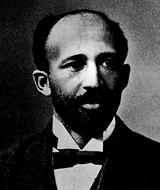
Not too long afterward, Haitian President Jean-Pierre Boyer invited American Blacks to resettle in Haiti. This invitation was as per the Haitian constitution, which guarantees a home to all people of African descent. Richard Allen, the founder of the African Methodist Episcopal Church, led approximately 2,000 people to the Caribbean in the mid 1820?s. Among the group led by Allen to Haiti was Alexander Du Bois who stayed in there for about a decade before he returned to the United States. With him, he brought a son born there, Alfred, who later became the father of W. E. B. DuBois.

WEB%20DUBOIS.GIF


The contributions of Haiti and her children to oppressed people around the world in general and Black people in America specifically are too numerous to mention in this brief space. However, if the above is not enough to finally convince the reader of the special cause for celebration for all people of African descent on January 1st, then perhaps nothing will awaken such pride within the conscious.


That is because to celebrate Haitian independence on January 1st is akin to the more commonly known Black power mantras first made popular in this country during the 1960?s. To lift one?s voice in praise of the sacrifices of tens of thousands of forever unknown Africans in Haiti two hundred years ago is to continue what luminaries such as Jamaica?s Marcus Garvey and Trinidad?s George Padmore worked so tirelessly for in the 20th century. To always remember and remind others that Haiti ?was the first of the New World in which the black man asserted his right to be free and was brave enough to fight for his freedom and fortunate enough to gain it,? as Douglass said, is to do your part to express gratitude for how Haiti ?grandly served the cause of universal human liberty.? To teach your children Haiti?s motto ?L?union fait la force? (in unity there is strength), is to ensure that neither they nor their children will have to suffer through what your parents and their parents did during less free times in this country.

2974538.jpg


Put most simply and truthfully, when you say ?Vive Haiti?, you are declaring that ?Black is very beautiful.?
 
an old Haitian saying...

Piti, piti, wazo fe nich li.


maron.jpg


Little by little, the bird builds its nest.
 
Honor Haiti, Honor Ourselves

Forget Haiti, Forget Ourselves

By RANDALL ROBINSON

Part I

January 1, 1804--January 1, 2004:

This day is sacred.

It is the 200th anniversary of the Haitian Revolution.

Fought by Haitians.

Won for us all.

Between 1791 and 1804, hundreds of thousands of Africans enslaved in Haiti
ignored the rivers, forests, precipices, swamps, mountains, gorges,
bloodhounds, rifles, cannon, and whips that separated them and united to
launch a massive, brilliantly executed, spectacular war of liberation that
the armies of Spain, England, and France (with the help of the United
States) all fought desperately--and failed absolutely--to crush.

The Haitian Revolution was no "lucky break" involving "a few unruly
slaves."

This was no "plantation uprising."

St. Domingue (as Haiti was then called by the French) was at that time the
most prosperous colonial possession of any European power. It created far
greater wealth for France than the thirteen American colonies combined. Its
massive wealth-generating capacity caused it to be known far and wide as
"The Pearl of the Antilles" and its French owners had a clear and proven
management strategy for profit maximization: push the slaves to their
absolute physical limit, work them literally to death, and then quickly
import replacement slaves from Africa who would, in turn, be worked to
death. This, St. Domingue's plantocracy had discovered, controlled operating
costs, kept the pace of economic activity at a highly efficient and
productive pace, minimized slack and wastage, and produced massive,
stupendous profits.

Two hundred years ago today, however, after a 13-year war of liberation,
the slaves of St. Domingue celebrated their victory over France and other
European powers by establishing the Republic of Haiti. They had wrested from
Napoleon the engine of France's economic expansion, banished slavery from
the land, and ended European domination of 10,000 square miles of fertile
land and hundreds of thousands of slaves to work it.

They had shattered the myth of European invincibility.

"Most have assumed that (Haiti's) slaves had no military experience prior
to the revolution," John K. Thornton explains in African Soldiers in the
Haitian Revolution. "Many assume that they rose from agricultural labour to
military prowess in an amazingly short time.... However, it is probably a
mistake to see the slaves of St. Domingue as simply agricultural workers,
like the peasants of Europe... ...A majority of St. Domingue's slaves,
especially those who fought steadily in the revolution, were born in
Africa... ...In fact, a great many... ...had served in African armies prior
to their enslavement and arrival in Haiti... ...Sixty to seventy per cent of
the adult slaves listed on (St. Domingue's) inventories in the late 1780's
and 1790's were African born... ... ...(coming) overwhelmingly from just two
areas of Africa: the Lower Guinea coast region of modern Benin, Togo and
Nigeria (also known as the "Slave Coast"), and the Angola coast area....

"Where the African military background of the slaves counted most was in
those areas, especially in the north (of St. Domingue), where slaves
themselves led the revolution, both politically and militarily... ..
...These areas...threw up the powerful armies of Toussaint Louverture and
Dessalines and eventually carried the revolution."

A successful revolution in Haiti, Thornton explains, "required the kind of
skill and discipline that could be found in veteran soldiers, and it was
these veterans, from wars in Africa, who made up the general will of the St.
Domingue revolt... ...Kongolese armies contributed the most to St. Domingue
rebel bands... ...(Their) tactical organization was very different from that
of Europe... ...(and they) had learned to deal successfully with Portuguese
armies and tactics in the years of struggle (in Africa), driving out
invaders... ...No doubt these tactics could help those who found themselves
in St. Domingue on the eve of the revolution.

"Kongolese armies seem to have been organized in...platoons...that struck
at enemy advancing columns and sustained an engagement for a time before
breaking off and retreating... ...They made use of cover, both from terrain
and from woods and tall grass, in hiding their movements and directing their
fire. When they fled it was not possible to follow them." Portuguese troops
who had fought the Kongolese in Africa also reported that the Kongolese used
"shocks--larger engagements involving massed Kongolese units. According to
the Portuguese accounts, large bodies were assembled for shocks supported by
artillery, sometimes they formed in extensive half moon formations which
apparently sought partial envelopment of opposing forces, in other cases in
columns of great depth along fronts of 15-20 soldiers....

"Their tactics showed a penchant for skirmishing attacks rather than the
heavy assaults favoured by Europeans in the same era... ..Kongolese armies
had a higher command structure that could mass troops quickly, and soldiers
were also accustomed to forming effectively into larger units for major
battles when the situation warranted.... ...Dahomey's armies included a
fairly large professional force... ...Oyo relied heavily on cavalry forces,
had relatively few foot soldiers and throughout the 1700's was the
pre-eminent...military power in (west Africa)... ...Dahomey's troops...
..fought in close order using fire discipline quite similar to that of
Europe... ...

"It was from these disparate 'arts of war' that the revolutionary African
soldier of St. Domingue was trained... ..

"One can easily see, in the formation of the bands mentioned in the early
descriptions of the (Haitian Revolution), the small platoons of the
Kongolese armies, each under an independent commander and accustomed to
considerable tactical decision making; or perhaps those small units
characteristic of locally organized Dahomean units; the state armies of the
Mahi country; or the coastal forces of the Slave Coast... ..

"In addition the pattern of attacks with small scale harassing maneuvers,
short, sustained battles and then rapid withdrawals are also reminiscent of
the campaign diaries of the Portuguese field commanders in Angola. Felix
Carteau, an early observer of the war in the north of St. Domingue noted
that the (slave revolutionaries) harassed French forces day and night.
Usually, he commented, they were repelled, but each time, they dispersed so
quickly, so completely in ditches, hedges and other areas of natural cover
that real pursuit was impossible. However, rebel casualties were light in
these attacks, so that the next day they reappeared with great numbers of
people. They never mass in the open, wrote another witness, or wait in line
to charge, but advance dispersed, so that they appear to be six times as
numerous as they really are. Yet they were disciplined, since they might
advance with great clamor and then suddenly and simultaneously fall
silent....

"It was not long before observers noted that the rebels (in St. Domingue)
had developed the sort of higher order tactics that was also characteristic
of Kongolese forces, or those of the Slave Coast....

"In addition to these tactical similarities to African wars, especially in
Kongo, there were other indications of the African ethos of the fighters...
...they marched, formed and attacked accompanied by the 'music peculiar to
Negroes....' Their religious preparation, likewise, hearkened back to
Africa....

"It is unlikely that many slaves would have learned equestrian skills as a
part of their plantation labor... ...Since there was virtually no cavalry in
Angola, one can speculate that rebels originating from Oyo might have
provided at least some of the trained horsemen. Also, the Senegalese, though
a minority, also came from an equestrian culture... ..

"African soldiers may well have provided the key element of the early
success of the revolution. They might have enabled its survival when it was
threatened by reinforced armies from Europe. Looking at the rebel slaves of
Haiti as African veterans rather than as Haitian plantation workers may well
prove to be the key that unlocks the mystery of the success of the largest
slave revolt in history."

St. Domingue's policy of working its slaves to death and then quickly
importing replacements from Africa proved to be the ultimate karmic
boomerang. St. Domingue's African-born slaves not only were not yet broken
psychologically, but they were also in possession of significant military
training and experience gained on the other side of the Atlantic. And they
combined with brilliant, indefatigable, St. Domingue-born blacks like
Toussaint L'Ouverture and Dessalines to create a black revolutionary
juggernaut the likes of which Europe and the United States had not seen
before--or since.

The blacks of St. Domingue forced the world to see both them and the
millions of other Africans enslaved throughout the Americas with new eyes.
No longer could it be assumed that they could forever be brutalized into
creating massive fortunes and building sprawling empires for the glory of
Europe and America.

On January 1, 1804, hundreds of thousands of slave revolutionaries
established an independent republic and named it Haiti in honor of the
Amerindian people, long since killed off by European brutality and diseases,
who had called the land Ayiti--Land of Many Mountains. They had banished
slavery from their land and proclaimed it an official refuge for escaped
slaves from anywhere in the world. They had defeated the mightiest of the
mighty. They had shattered the myth of European invincibility.

Europe was livid. America, apoplectic. The blacks in St. Domingue had
forgotten their place and would be made to pay. Dearly. For the next two
hundred years.

Toussaint L'Ouverture, Dessalines, and their slave revolutionaries must
forever live in our hearts as inspiring, authentic counterweights to the
"yassuh-nosuh-scratch-where-ah-don'-itch-and-dance-tho-there -ain'-no-music"
image of our forebears that Europe and the United States have drilled into
our psyches.

And we must remember that history forgets, first, those who forget
themselves. Via means direct and indirect, crass and subtle, there have been
whispers and street corner shouts that "current conditions in Haiti" make
our celebration of the Haitian Revolution "inappropriate" at this time.

We, whose souls and psyches have been bleached of everything prior to the
Middle Passage are now being told that we must tear from our consciousness
and rip from our hearts the most dramatic and triumphal assertion of
forebears' dignity, worth, and perspicacity since the Middle Passage.

How diabolically contemptuous.

Not only must we not forget the Haitian Revolution, we must celebrate it.
Today, through all of this its bicentennial year, and beyond.

And we must research, understand, and expose what happened to Haiti and in
Haiti since the revolution. We must become fully conversant with the role of
"the world's leading democracies" in Haiti between 1804 and today. We must
develop a keen understanding of the repercussions of the 61-year economic
embargo that the United States imposed on Haiti in response to its
declaration of independence, and we must recognize the current-day
consequences of France forcing Haiti to pay 90 million in gold francs
(equivalent today to some $20 billion) in 1825 as "compensation" for Haiti
declaring its independence--or be crushed militarily by France.

Today, "the world's leading democracies" cluck and gloat at their ongoing
stranglehold--in the form of a crushing financial embargo--on today's
descendants of Toussaint, Dessalines, and their freedom fighters. Throughout
the Americas, we who benefited from the daring war waged by the slaves of
St. Domingue, must reject the maneuverings of the world's most powerful
nations in Haiti and find ways to build bridges to the Haitian people and
the officials they choose--through the ballot--to lead them.

Just over two hundred years ago, after there had been a "cessation of
hostilities" and the brilliant military strategist Toussaint L'Ouverture had
already retired to a quiet life in the St. Domingue country-side, France
decided, nonetheless, to arrest and ship him to a prison cell 3,000 feet up
the Jura Mountains of France where he would freeze to death. As he stepped
on board the boat that would forever take him away from St. Domingue,
Toussaint issued a promise to his captors and a call to us all.

"In overthrowing me, you have cut down in St. Domingue only the trunk of
the tree of liberty. It will spring up again by the roots for they are
numerous and deep."

We are those roots.

The revolution was fought by Haitians, but won for us all.

Through our work and with our resources, in a spirit of self-respect and
self-awareness, we must serve as counterweights to the powerful nations who
deem the ballot box sacrosanct in their countries, but surreptitiously
encourage and manipulate its rejection by "the opposition" in Haiti. We must
serve as proponents of political civility and social justice in Haiti while
"the world's leading democracies" slyly encourage recalcitrance, tumult, and
division. We must reject being manipulated by the corporate media into
embracing the notion that in France, Germany, the United States and other
"civilized nations" elections are the only legitimate determinant of the
will of the people, but in Haiti those street demonstrations specially
selected by the corporate media for coverage tell us all we need to know
about anybody's will. We must impress upon all Haitians the fact that the
outside world does not distinguish between--and cares nothing
about--Lavalas, Convergence, or any other
political grouping. The world sees only "Haiti," "Haitians," and all the
connotations that western media have attached thereto. Those nations that
two hundred years ago failed desperately in their attempts to crush the
Haitian Revolution today have a deep psychic need to "prove" Toussaint's
progeny capable of nothing but disaster. We must reach out to and work with
our Haitian brothers and sisters to prove these nations wrong.

Throughout the Diaspora, we must stand with and defend Haiti--on this the
anniversary of the Haitian Revolution, throughout this bicentennial year,
and for all time. For in so doing, we stand for and defend ourselves.
 
Part II

Haiti, Jessica, and WMD

America's foreign policy officials have perpetrated horrific untruths
recently. Iraq's "weapons of mass destruction," Jessica Lynch's "battlefield
heroism" and "abuse," and Aristide's "failure to deliver" in Haiti are cases
in point.

Iraq's oil, the fear of war-triggered terrorism, and Iraq's antiquity have
made us more aware, and less susceptible--though not immune--to media
manipulation regarding Iraq. Similarly, American soldiers who have served in
Iraq have American defenders who will not allow these soldiers'
contributions to be overlooked while, for example, Jessica Lynch's truth is
trampled and twisted to whip up "patriotism" and animus for "the bad guys."

Who, however, knows or cares anything about Haiti? How many Americans know
that--in our names--American policy-makers have used our country's enormous
power to block 8 million Haitians' access to approved loans for safe
drinking water, literacy programs, and health services? How many know, when
we read about "Haiti's steady slide," that powerful American policy-makers
are massively responsible? These officials are holding the Haitian people,
who desperately want to own their democracy, in a brutal economic
death-grip. Is this the face that America intends to continue showing to the
black and brown peoples of the world? Ordinary Americans can no longer
afford indifference.

Our president says that we are terrorism targets because "they are jealous
of us"; because "we love liberty and they do not"; because we represent
"truth and justice."

Is it really our compassion and magnanimity that cause the rage in distant
hearts to reduce Bali tourist spots to embers, Manhattan towers to dust, and
our Nairobi embassy to rubble? If so, the Dali Lama is in great danger.

In these times, Americans must assess what our policies are doing to human
beings beyond our shores. And we must realize that the same "information"
machine that lied about WMD and Jessica Lynch lies about much
more--including Aristide and Haiti.

The United States has had Haitian blood on its hands for a long time.
Today, they are dripping.

In 2000, the year of our electoral meltdown, election observers in Haiti
recommended that seven senate seats (out of a total of 7,500 positions
filled nation-wide) go to a run-off. Haiti's electoral commission disagreed,
creating the only international concern about the election. To avoid "the
wrath of the mighty," these senators resigned. However, American officials
who had vehemently opposed the restoration of Haiti's elected government in
1994, now seized on the run-off controversy to further demonize Aristide,
break the Haitian people's spirit, and "prove" the Haitian Revolution a
failure

Powerful Americans are crushing the Haitian people's dream of building
their own democracy in their own image, and these officials blocking
Haitians' access to safe drinking water tells us all we need to know. They
loathe Aristide because he represents the poorer, blacker masses of Haitian
society, whereas America's traditional allies have always been Haiti's
moneyed, white or mulatto "elite." The parallels between America's policies
toward Haiti and our policies towards apartheid South Africa have never been
lost on me.

During my colleagues' and my battle to end America's long-standing
collusion with South Africa's white supremacist government, highly respected
U.S. government officials publicly asserted that Mandela and the African
National Congress were terrorist and that the anti-apartheid movement was
antithetical to U.S. interests. Aristide's government was restored in 1994
following a coup in which Haiti's US-allied army killed 5,000 civilians. And
those American officials who had defended apartheid South Africa lost no
time in turning their policy venom full bore on today's descendents of the
most spectacular slave revolt in the history of all the Americas--and the
man Haitians chose to lead them.

Aristide has not "failed to deliver." Powerful individuals from the most
powerful nation on earth have placed a financial embargo on his country and
made the strangulation of his government--and therefore his people--a
priority. They are determined to render him incapable of delivering so that
his people will, in time, tire of the excruciating hardships and tire of
him.

At the dawn of this New Year, perhaps we should reflect on what we have
done to Aristide, what we have done to the Haitian people, and on Thomas
Jefferson's lament: "When I consider that God is just, I shudder for my
country." The way we continue to treat weaker peoples and nations around the
world will determine, for years to come, whether justice is something
Americans have reason to welcome or something we have reason to dread.

Randall Robinson is founder and former president of TransAfrica. He is an
author and lives in the Caribbean.
 
Lies About Haiti
The Black Commentator

At some point in recent history the U.S. corporate media, formerly mere racist butt-kissers to the powerful, abandoned the profession of journalism entirely to become active agents of disinformation. Nowhere is this more evident than in the criminal conspiracy that poses as American press coverage of Haiti?s 200th anniversary as the first Black republic on Earth. On New Years Day and other publications received the following letter from Michelle Karshan, Foreign Press Liaison for Haitian President Jean-Bertrand Aristide:

I am still in shock by the numbers who turned out for today's celebrations at the National Palace. The foreign press had been reporting for weeks that there was nothing to celebrate and that the President had a hard time getting crowds out in support of his government. Well, I guess the people of Haiti do feel that they have something to celebrate despite living under a crushing, debilitating economic embargo!

During today's celebrations at the National Palace I asked lots of people working in the Palace how many people did they think were in the streets around the Palace and on the Palace grounds. They all looked at me and said a lot, too many to count! I asked them whether they thought the numbers were the same as the annual carnival and they said there were more folks. Carnival is typically reported at 1 million or 1 1/2 million.

Many of the people I talked to said the foreign press would tell the truth today because they were here and saw for themselves how many people there were. I shook my head no, that telling them that the foreign press has personally witnessed many events in Haiti and still under reported the numbers. I did ask a couple of foreign press what their estimates were and they stared back as if to say it was beyond their capability to estimate such a large crowd.

Well today takes the cake as I just read Paisley Dodd's AP piece which says: "About 10,000 Haitians gathered at the palace hours after celebrating New Year's Day with fireworks crackling, shots ringing out and drums pulsing in the darkness." What Palace was she at, pray tell?

I ask all of you who were here to send me your estimations to the press with copies to me and I will share them with the press as well! Of course, they are busy filing their stories as I am writing this but perhaps it will have some impact down the line. Also, please everyone share with me the numbers that you are reading, hearing on radio, or the angles of the shots shown on television to see if there is accurate reporting on this historic occasion.

I remember when I marched in the demonstration in New York against the coup d'etat and the police put the numbers at 80,000. Those numbers were fixed by New York City Police authorities and we believed them to be underestimated at the time. Well, today's celebration was several times the numbers I saw that day in New York.


I just discussed this with an astute friend of mine who pointed out that perhaps journalists will keep the numbers down so as not to reflect any crowd that may be larger than the demonstrations waged by the opposition lately. Maybe that's what accounts for this week?s reporting when journalists reported just thousands of Lavalas demonstrating in Petionville when everyone here on the grounds knew it was an enormous rally forcing even conservative press to call it significant and important in numbers. So sad the outside world may never know about it!

Yesterday President Aristide spoke of a systematic organized disinformation campaign against Haiti. I need say no more.

The same Paisley Dodds that Karshan spoke of filed a January 2 Associated Press report on the bicentennial celebrations that failed to include a single quote from President Aristide, visiting South African President Thabo Mbeki, or any member of over a dozen official foreign delegations. Instead, the despicable Dodds provided her global platform to Andy Apaid Jr., a leader of the U.S.-backed opposition. President Mbeki?s visit ?brought oxygen to a dying dictatorship" said Apaid, the corrupt business oligarch. The Washington Post ran Dodds? story under the headline, ?Haiti Opposition Demands Aristide Resign? ? as if that were news!

The New York Times? January 2 headline dismissed the celebration and the entire post-slavery history of Haiti ? in almost exactly the words predicted by Ms. Karshan: ?200 Years After Napoleon, Haiti Finds Little to Celebrate.? The vast throng described by the Haitian press liaison was shrunken to a ?crowd, which filled a city block and rows of bleachers set up in front of the white presidential palace in the center of the city.?

The Times followed up on Sunday with an Op-Ed article by a University of Virginia professor, titled ?For Haiti, 200 Years of Mixed Results.? The piece called for a ?transitional government? in which Aristide would ?share power with a prime minister from the opposition? ? in effect, an overthrow of Haiti?s elected government. This is undoubtedly the position of the editorial board of the New York Times, as well.

Thus, the U.S. corporate media actively suppress the news in service of the propaganda and goals of the party in power in Washington.

TransAfrica founder Randall Robinson framed the issue succinctly in his January 1 article, ?Haiti ? A call for Global Action: Honor Haiti, Honor Ourselves; Forget Haiti, Forget Ourselves.?

We must reject being manipulated by the corporate media into embracing the notion that in France, Germany, the United States and other ?civilized nations? elections are the only legitimate determinant of the will of the people, but in Haiti those street demonstrations specially selected by the corporate media for coverage tell us all we need to know about anybody?s will?.
Today, ?the world?s leading democracies? cluck and gloat at their ongoing stranglehold ? in the form of a crushing financial embargo ? on today?s descendants of Toussaint, Dessalines, and their freedom fighters. Throughout the Americas, we who benefited from the daring war waged by the slaves of St. Domingue, must reject the maneuverings of the world?s most powerful nations in Haiti and find ways to build bridges to the Haitian people and the officials they choose ? through the ballot ? to lead them.
 
Fri, Jan. 09, 2004

Local Haitian activists critize Bush immigration plan
Jacqueline Charles
[email protected]

South Florida Haitian-American leaders Friday called on President George Bush to support more ''meaningful'' immigration reform that would put undocumented residents on a clear path to U.S. citizenship.

The leaders said Bush's plan, unveiled this week, leaves out thousands of Haitians and other undocumented immigrants who have been living in the U.S. for years.

Under the Bush plan, Congress would create a temporary worker program open to undocumented workers now in the United States -- many of them from Mexico -- and to foreigners who want to come. They would get a work permit for three years and have the possibility of applying for permanent U.S. residency, which would allow them to eventually become U.S. citizens.

Members of the Haitian-American Grassroots Coalition, Haitian Lawyers Association and Haitian Women of Miami called the plan a temporary fix.

''We feel a lot of people will be left out,'' said Jean-Robert Lafortune, chairman of the Haitian-American Grassroots Coalition. ``We need a comprehensive legalization program.''

Lafortune and others said they would like to see the Bush administration support the Haitian Refugee Immigration Fairness Act (HRIFA) Improvement Act of 2003. Introduced by U.S. Rep. Kendrick Meek, D--Miami, last fall, the act would provide legal residency to between 20,000 and 35,000 Haitians who are currently in danger of being deported.


Haiti makes its case for reparations, The meter is running at $34 per second by
J. Damu (San Francisco Bay View)

You've got to hand it to Haiti. Not only was it the world's first country of
enslaved workers to stand up and demand their freedom and independence; now they
are the world's first country to stand up to their former slavery-era master,
France, and demand the return of its stolen wealth. Everyone say "Amen."

Haiti's president and other government officials claim their country was held up
at gunpoint in broad daylight in 1825 and now they want the admitted thief,
France, to replac e the stolen wealth to the tune of $21.7 billion. This,
despite massive attempts, well documented elsewhere, by the United States and
world lending institutions to destabilize and overthrow the democratically
elected government of Jean Bertrand Aristide.

Government officials also say, due to forced efforts to hand over its wealth in
a timely manner to France, the coerced payments so distorted and stunted the
economy, Haiti feels the effects to this day. They also say, due to those
efforts, Haiti became saddled with a form of class oppression that resembles
racism.

In a soon to be published booklet provided to a U.S. reporter by the foreign
press liaison to President Jean Bertrand Aristide, Haitian government officials
dissect the 1825 "agreement" that initially forced Haiti to pay to France 150
million francs in exchange for liberty.

The booklet, like Haiti's restitution claim, is based largely on the research of
Dr. Francis St. Hubert, a member of the government's Haiti Restitution
Commission.

"I did most of my research in New York at the Columbia University Library and
the Schomburg Center," Dr. Hubert said by phone from Port-au-Prince.

"We are pursuing this case from three different angles. We are doing publicity
and educational campaigns, we are pursuing our claims through the diplomatic
community, and we are preparing a legal case," he said.

"Haiti's claim is not really for reparations for slavery," said Ira Kurzban,
Miami immigration attorney and Haiti's chief counsel in the U.S., "but for
restitution specifically that happened in 1825. It is based on the French
government's efforts to extract 150 million French francs (which is equal to $21
billion today) from an economy the French knew couldn't afford it, through the
use of force. This is impermissible under international law."

"I can't tell you how we plan to proceed legally," he said by telephone. The
Haitians will make their own announcement when they are ready, he said.

According to the booklet, which will soon be published under the name of the
Haiti Restitution Commission, following the 1804 revolution that expelled
France, Haiti was divided into two districts, northern and southern, but was
re-united following the death of Henri Christophe in 1820. Under the new
president, Jean Pierre Boyer, diplomatic notes began to be exchanged with
various French functionaries on the diplomatic recognition of Haiti.

Finally in 1825, France, which was being encouraged by former plantation owners
to invade Haiti and re-enslave t he Blacks, issued the Royal Ordinance of 1825,
which called for the massive indemnity payments. In addition to the 150 million
franc payment, France decreed that French ships and commercial goods entering
and leaving Haiti would be discounted at 50 percent, thereby further weakening
Haiti's ability to pay.

According to French officials at the time, the terms of the edict were
non-negotiable. And to impress the seriousness of the situation upon the
Haitians, France delivered the demands by 12 warships armed with 500 canons.

The 150-million-franc indemnity was based on profits earned by the colonists,
according to a memorandum prepared by their lawyers. In 1789, Saint Domingue -
all of Haiti and Santo Domingo - exported 150 million francs worth of products
to France. In 1823 Haitian exports to France totaled 8.5 million francs, exports
to England totaled 8.4 million francs, and exports to the United States totaled
13.1 million francs, for a total of 30 million francs.

The lawyers then claimed that one half of the 30 million francs went toward the
costs of production, leaving 15 million francs as profit. The 15 million franc
balance was multiplied by 10 (10 years of lost revenues for the French colonists
due to the war for liberation), which coincidentally totals 150 million francs,
the value of exports in 1789.

To make matters worse for Haiti, the French anticipated and planned for Haiti to
secure a loan to pay the first installment on the indemnity. Haiti was forced
to borrow the 30 million francs from a French bank that then deducted the
management fees from the face value of the loan and charged interest rates so
exorbitant that after payment was completed, Haiti was still 6 million francs
short.

The 150-million-franc indemnity represented France's annual budget and 10 years
of revenue for Haiti. One study estimates the indemnity was 55 million more
francs than was needed to restore the 793 sugar plantations, 3,117 coffee
estates and 3,906 indigo, cotton and other crop plantations destroyed during the
war for independence.

By contrast, when it became clear France would no longer be in a position to
capitalize on further westward expansion in the Western hemisphere, they agreed
to sell the Louisiana Territory, an area 74 times the surface area of Haiti, to
the U.S. for just 60 million francs, less than half the Haitian indemnity.

Even though France later lowered the indemnity payment to 90 million francs, the
cycle of forcing Haiti to borrow from French banks to make the payments chained
the Black nation to perpetual poverty. Haiti did not finish paying her indemnity
debt until 1947!

According to the Haitian government's reparations booklet, the immediate
consequence of the debt payment on the Haitian population was greater misery.
The first thing President Boyer did to help pay the debt was to increase from 12
to 16 percent all tariffs on imports to offset the French discount.

The next step Boyer took was to declare the indemnity to be a national debt to
be paid by all the citizens of Haiti. Then he immediately brought into being the
Rural Code.

By Haitian First Lady Mildred Aristide's account in her book, "Child Domestic
Service in Haiti and its Historical Underpinnings," the Rural Code laid the
basis for the legal apartheid between rural and urban society in Haiti. With the
Rural Code, the economically dominant class of merchants, government officials
and military officers who lived in the cities legally established themselves as
Haiti's ruling class.

Under the Rural Code agricultural workers were chained to the land and allowed
little or no opportunity to move from place to place. Socializing was made
illegal after midnight, and the Haitian farmer who did not own property was
obligated to sign a three-, six- or nine-year labor contract with a large
property own er. The code also banned small-scale commerce, so that agricultural
workers would produce crops strictly for export.

The Haitian Rural Code was all embracing, governing the lives not only of
farmers but of children as well.

The Rural Code was specifically designed to regulate rural life in order to more
efficiently produce export crops with which to pay the indemnity. The taxes
levied on production were also used predominantly to pay the indemnity and not
to build schools nor to provide other social services to the generators of this
great wealth, the peasants.

Leading Haitian activists in the U.S. claim that between 1804 and 1990, when
President Aristide was first elected, a grand total of 32 high schools were
built in Haiti, all within urban settings. Since then, more than 200 have been
built, they say, most in the countryside.

To this day, the discrimination between rural and urban areas takes the form of
color discrimination by light-skinned Blacks toward darker-skinned Blacks, and
it remains intense.

St. Hubert and the national bank compute the exact amount Haiti is demanding
from France as $21,685,135,571.48, at 5 percent annual interest.

"France is getting off easy," St. Hubert told a U.S. newspaper. If Haiti charged
7.5 percent interest on the money, "France would owe $4 trillion today and much
more tomorrow.

"The French can debate whether they want to pay as long as they like," he said,
" but at 5 percent interest, it will cost them $34 per second."

For more information about Haiti or to learn what you can do to support Haiti,
call the Haiti Action Committee at (510) 483-7481, write them at HAC, P.O. Box
2218, Berkeley CA 94702 or visit their website at http://www.haitiaction.org.
 
good info

Thanks for the history lesson!

I have a really good friend who is from Haiti and he, like many others, moved to Long Island, NY when he was about 12. I have learned a lot from him about Haitian culture, which is not unlike our own in Louisiana. Not many folks realize that. Since becoming friends with him I have been very interested in all things Haitian.

And I love all of Edwidge (sp) Danticat's books. She's very good at making you feel and understand Haitian culture. I would love to visit some day.
 
Edwige is a real sweetie pie.

She is as docile, humble, kind, and gentle of a spirit as i have ever had the pleasure of meeting.

If you do go to Haiti, make sure to include Jakmel in your travel plans.
 
This was the headline story in yesterday's (Sunday) AJC
There were some very riveting pictures too.

Hassan,
what's your take on this?

Haiti on the brink
Nation haunted by violent past sees cycle gear up again
Mike Williams - Cox Washington Bureau
Sunday, February 15, 2004

St. Marc, Haiti --- The boys stand silently on the barren slope, some kicking at pebbles in the dust between stolen glances, while the grown-ups murmur in hushed voices.

The gruesome sight has sucked the sound and life from this place for a moment: the mangled body of a man --- a victim of Haiti's political violence --- partially eaten by animals, sprawled in a dirt gully on the steep hillside overlooking this port city.

"He was shot as he ran from the attackers," murmurs one of the grown-ups. "There are other bodies nearby. Nobody comes for them because their families ran away, afraid for their lives."

full story
http://www.ajc.com/sunday/content/epaper/editions/sunday/news_04f272cb0384208b0006.html
 
sorry i am getting back so late

it has been CRAZY

there is a LOT to share on this issue - especially now (for example, the latest is that gunshots are being reported in Port au Prince as it appears that the coup has moved into the capital)

i spoke on the telephone this past monday with my publisher in california about writing a story on this so i have been trying to get caught back up

between Lavalas, Convergence, 184, et al - this place is going bananas

we've had a pretty good discussion going at MF.com but i do want to contribute here too

stay tuned y'all - it is getting worse in Haiti

*also, the French want to come in to "help" which is ironic considering they've never done so since the Haitians drove them into the sea two hundred years ago and now the Haitians are talking about the French owing them over $22 Billion dollars for a wrongfully imposed indemnity

stay tuned.....
 
thank you professor

here is a little more "context":

Haiti: A Primer in Injustice
By hassan


Many of the readers of this column may not remember Patrice Lumumba. Lumumba was the democratically elected head of state for an independent African nation who earned mass support among the majority of his impoverished constituents with his genuine anti-colonial platform. Naturally, the same ideology that won him the adoration of his people also marked him as a target for ?The Man.? Lumumba eventually was faced with a radical separatist movement led by a power hungry thug. Naturally, that ambitious rogue enjoyed the financial support of ?The Man.?

According to a Central Intelligence Agency station chief, Lumumba was eventually ?delivered? to that same thug by, you guessed it, ?The Man.? Eventually, with his people?s elected government stolen, Lumumba was tortured and killed by a firing squad.

Many historians are not very religious but most do believe and swear by the ancient credo ?History repeats itself.? It is because of times like these that this writer has to agree. A little over forty years after the rise of and robbery of Lumumba?s nationalist dream, the same thing is happening all over again ? with almost little deviation from the original script ? to Haiti?s President: Jean-Betrand Aristide.

Aristide won much of the same support of Haiti?s poor Black masses that Lumumba did in the Congo. He also received much of the same hate from ?The Man? that Lumumba did. Like Lumumba, Aristide has been abducted and is being held under guard while his fate is being bargained on.

Like Lumumba, Aristide has been the target of corporate media lies that are meant to both cover up and justify punitive actions by ?The Man.?

Let us begin with the first lie: Aristide won the 2000 Presidential election in Haiti by fraud.

When detractors go out of their way to talk about the ?flawed election? of 2000, they are actually talking about the parliamentary elections held that year. During those legislative elections, only eight seats were questioned. Those seats were questioned because the winners in each of those instances won by a plurality of votes, not a majority. In other words, the winners did not garner more than half of the votes cast but they did garner more than their opponents. The real problem for the opposition arose because each of those seats were won by Lavalas party members. Lavalas is the party of which Aristide was the head of.

Crying foul almost before the dust finished settling on election day, the opposition began a campaign of political tantrums made almost legendary by its stamina. They continued to scream ?fraud? so often that, eventually, some of them actually started to believe it.

Contrary to the fabricated image of a brutal Latin American dictator conjured up by mainstream mass media and hostile administrations, Aristide offered ? on many occasions ? to hold new parliamentary elections. Like a spoiled child, the opposition refused to participate in any new elections. Instead, they preferred to call for the immediate removal of Aristide from the President?s office.

Of course, the opposition did not satisfy itself with merely calling for his ouster ? they also worked for it too. With the aid of right-wing Haitians living aboard and the complicity of some foreign governments, the opposition?s monetary, military, and ? most dangerously ? media strength grew as its electoral strength weakened.

To whit, members of the opposition have acknowledged the popular support of Aristide. In a story published by The Miami Times in 2002, opposition member and former Jean-Claude Duvalier cabinet member Daniel Supplice admitted that the Aristide administration was ?the most popular government Haiti?s ever had.?

With that financial help, the opposition was able to assemble a cast of cutthroats and killers, thieves and thugs with one thing in common: a sadistic disregard for the value of human life.

Among the more infamous leaders of the ?opposition? are the following death stars as profiled by the London-based Haiti Support Group:

? Louis Jodel Chamblain ? former co-leader of the Revolutionary Front for Haitian Advancement and Progress (FRAPH). Formed by the military junta that overthrew President Aristide during his first term in office in 1991, FRAPH (which also means ?to hit?) wreaked egregious havoc on the people of Haiti between 1991 and 1994 when President Aristide was restored to power. Chamblain was convicted (in absentia) and sentenced to a life term of hard labor for his involvement in the assassination of a pro-democracy activist. Like his infamous FRAPH co-leader Emmanuel ?Toto? Constant (who is enjoying the pleasures of freedom living in the United States), Chamblain escaped from Haiti to avoid the rule of law. Chamblain reappeared in Haiti recently to help overthrow the constitutionally-sanctioned Aristide government.

? Guy Phillippe ? the rebellion?s most camera-hungry personality was an officer in the same Haitian army that overthrew Aristide during the 1991 coup d?etat. While Haiti was being ruled by the aforementioned junta in the early nineties, Phillippe was one of several officers that was trained by the United State?s Special Forces in South America. After the newly-restored President Aristide disbanded (but did not disarm) the army upon his return, Phillippe managed to secure a post with the newly formed state police. He fled Haiti in 2000 when it was discovered that he (along with other police officials) was plotting another attempt to overthrown the government.


? Jean-Baptiste Joseph ? another former soldier, Joseph was the leader of the Assembly of Soldiers Retired Without Cause (a sort of militant VFW) in 1995. The Assembly was intimately tied to the Mobilization for National Development (MDN), a ?neo-Duvalierist party? that is described as ?leading member? of the Convergence Democratique, the primary alliance of opposition groups that pushed so hard for the outright violent removal of President Jean-Betrand Aristide. Like Phillippe, Joseph was accused of conspiring against the government. He was arrested but broken out of jail in a violent attack on the central police station in Port au Prince a few days later and never brought to trial.

? Jean Tatoune ? was a former ?local leader of FRAPH.? Ten years ago, on April 22, Tatoune (whose real name is Jean Pierre Baptiste) led a attack on a Gona?ves slum named Raboteau, which was a pro-Aristide enclave. When the carnage was done, ?between fifteen and twenty-five people were killed in what became known as the Raboteau massacre.? Convicted and imprisoned for the attack, Tatoune escaped from jail in Gona?ves in 2002 and cast his lot with Amiot Metayer?s Cannibal Army. Amiot was gunned down several months ago and his brother Butter has assumed control of the group.

Another prominent member of the opposition is U. S. citizen Andre Apaid of the Group of 184. Born in the New York City borough of Queens, Apaid is an affluent businessman that is ? like many affluent Haitians ? very anti-Aristide.

According to Mary Turck, editor of Connection to the Americas, the Convergence Democratique (along with other non-affiliated opposition groups) has been funded by the U. S. National Endowment for Democracy. In fact, the Resources to the Americas website reports that the NED ?set up the Haitian Conference of Political Parties (CHPP), a coalition of 26 ?opposition? groups.? The Resources website described the majority of the represented groups as ?right-wing? with many under the leadership of former cronies of both Duvalier regimes as well as that of ex-dictator General Henri Namphy.

In addition to pressure from the aforementioned, President Jean-Bertrand Aristide also was subjected to undue pressure from the neo-liberal economic entities of the World Bank and the International Monetary Fund. The economic model of neo-liberalism is one that insists upon the removal of trade barriers that normally protect immature industry, big cutbacks on social spending such as education, healthcare, and welfare, the stripping of workers? rights, and the privatization of national resources and assets.

The typical modus operandi of both the World Bank and the IMF is to lend money to poorer countries in exchange for the implementation of neo-liberal economic policies. Taking into account that Aristide?s power base has always been among the poor Black masses of Haiti, he was put in between the largest of rocks and the hardest of places. In order to get the money that his constituency needed, he would have to ?sell out.? If he held firm to his nationalist principles and populist ideologies, the neo-liberal organs would not approve the much-needed loans.

Of course, it was all moot. After finally being approved for a badly needed loan of approximately $300 million dollars, the United States moved to block the disbursement of the loan on grounds that Haiti held ?flawed? elections in May of 2000. The irony of the United States penalizing another country for ?flawed? elections in 2000 is rooted deeply in profound hypocrisy.

Also hypocritical is the United States going to Iraq and Afghanistan to fight for democracy while working to overthrow a democratically elected government in the Caribbean.

In a telephone interview earlier this week, Congresswoman Sheila Jackson Lee of Texas stated that she was ?outraged? by the actions of the Bush administration in Haiti.

Initially choosing to stay out of the fight being won by forces it supported, the White House ignored pleas by Representatives Jackson Lee, Maxine Waters and other members of the Congressional Black Caucus, the Caribbean Community, and even President Aristide himself to help quell the rebellion and restore order. Described by Congresswoman Waters as a ?wrong-headed policy?, the Bush team stood by and effectively let the legitimate government of Haiti be usurped by a band of bandits and mercernaries.

Further troubling are the rising allegations that not only did the U.S. military compel Aristide to resign and leave (under the threat of being turned over to Phillippe) but also that the Haitian President is being guarded by American and French soldiers in the tiny Central African Republic (a pseudo-nation state described as a French stooge).

What is probably most disheartening about all of this is that the information contained herein represents a mere fraction of what freedom-loving Americans should know about but do not. That, all by itself, it as sad as it gets.
 
Back
Top