
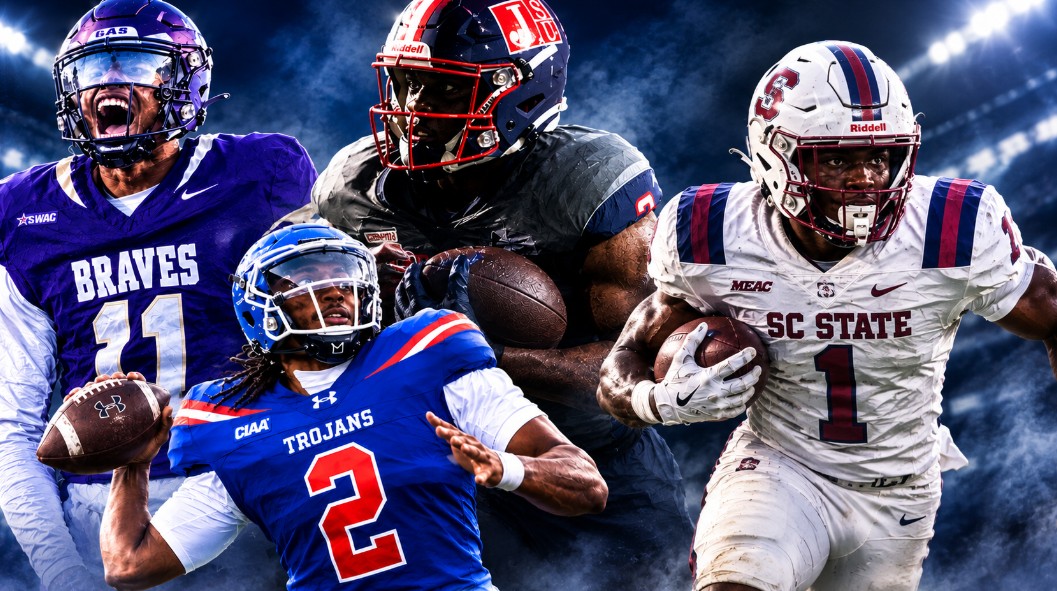
Four weeks into the 2026 HBCU football season, the race for the Black College Football Player of the Year Award is beginning to take shape.
The preseason watch list included 52 players, but four weeks of games have changed the conversation. Production matters more now.
So does winning.
And with the award open to players across HBCU football, the early race includes stars from both Division I and Division II.
Jaylon Tolbert, Alcorn State
Tolbert has been putting up quarterback numbers that are difficult to ignore.
Through five games, the Alcorn State senior has completed 120 of 180 passes for 1,471 yards and 13 touchdowns. He is completing 66.7% of his passes while averaging 294.2 passing yards per game. He has also rushed for 147 yards and a touchdown.
Those numbers have made Tolbert one of the most productive quarterbacks in HBCU football.
His best performance came in Alcorn State’s 53-51 double-overtime victory over Arkansas-Pine Bluff, when he threw for 485 yards and five touchdowns and added 36 rushing yards.
For now, he has perhaps the strongest pure statistical case among the Division I quarterbacks.
Mason Pickett-Hicks, South Carolina State
Pickett-Hicks might have the most complete résumé of the six.
South Carolina State is 5-0, and the Bulldogs have already collected wins over Florida A&M, Furman and Bethune-Cookman.
Pickett-Hicks has been central to that success.
Through five games, he has rushed for 613 yards on 66 carries — an astonishing 9.3 yards per attempt — while averaging 122.6 yards per game. He has scored three rushing touchdowns and added two touchdown receptions.
His 210-yard performance against Florida A&M remains one of the season’s most dominant individual outings.
Then he followed it with 112 yards against Virginia State and 136 yards against Bethune-Cookman. Against Bethune-Cookman, he averaged 9.7 yards per carry as South Carolina State produced 282 rushing yards.
The important distinction is that Pickett-Hicks isn’t simply piling up numbers.
He’s doing it while South Carolina State keeps winning.
Nate Blount IV, Jackson State
Nate Blount’s emergence has given Jackson State one of the most productive running backs in HBCU football — and his name deserves to be part of the Deacon Jones Award conversation.
Through four games, Blount has rushed for 411 yards on 59 carries, averaging 7.0 yards per carry with four rushing touchdowns. He has already posted two 100-yard games, including a career-best 135 yards and two touchdowns on 17 carries against Southern. He has also contributed as a receiver, with seven catches for 71 yards and a touchdown.
What makes Blount’s case particularly compelling is how quickly he has transformed from a player waiting for an opportunity into a central piece of Jackson State’s offense.
After appearing in only 12 games over his first two seasons and totaling just 32 rushing yards in 2025, the junior has exploded onto the scene in 2026.
Izaiah Jean-Baptiste, Edward Waters
Jean-Baptiste has arguably been the most explosive Division II receiver in the country through four weeks.
The Edward Waters senior has 24 catches for 448 yards and seven touchdowns through four games. He’s averaging 18.7 yards per reception and 112 receiving yards per game.
Those aren’t merely good numbers.
They’re award-caliber numbers.
Jean-Baptiste’s breakout came in Edward Waters’ 36-20 victory over Miles, when he caught nine passes for 144 yards and three touchdowns. The SIAC named him its Offensive Player of the Week for the performance.
The next challenge is maintaining that production as conference play intensifies.
Rahsaan “RJ” Matthews Jr, Virginia State
Virginia State quarterback Rahsaan “RJ” Matthews Jr. is already on the 2026 Deacon Jones Award watch list, and his numbers show why.
Through five games, Matthews has completed 94 of 143 passes for 1,263 yards and 10 touchdowns, while also rushing for 172 yards and three touchdowns.
He has helped Virginia State jump to a 4-1 overall record and 3-0 mark in CIAA play, while ranking among the conference’s top passers.
Corion Powers, Benedict
Powers gives the Division II side something the other candidates don’t: a defensive argument.
Through four games, the Benedict defensive back has recorded 29 tackles, including 17 solo stops, along with 1.5 tackles for loss, an interception and a quarterback hurry.
His impact showed up immediately.
Powers was named Defensive MVP of Benedict’s season-opening 32-10 victory over Johnson C. Smith. The following week against Shorter, he recorded 11 tackles and returned an interception 19 yards for a touchdown in a 24-20 victory.
Powers has already provided the kind of game-changing defensive plays that can force voters to look beyond quarterback and running-back numbers.